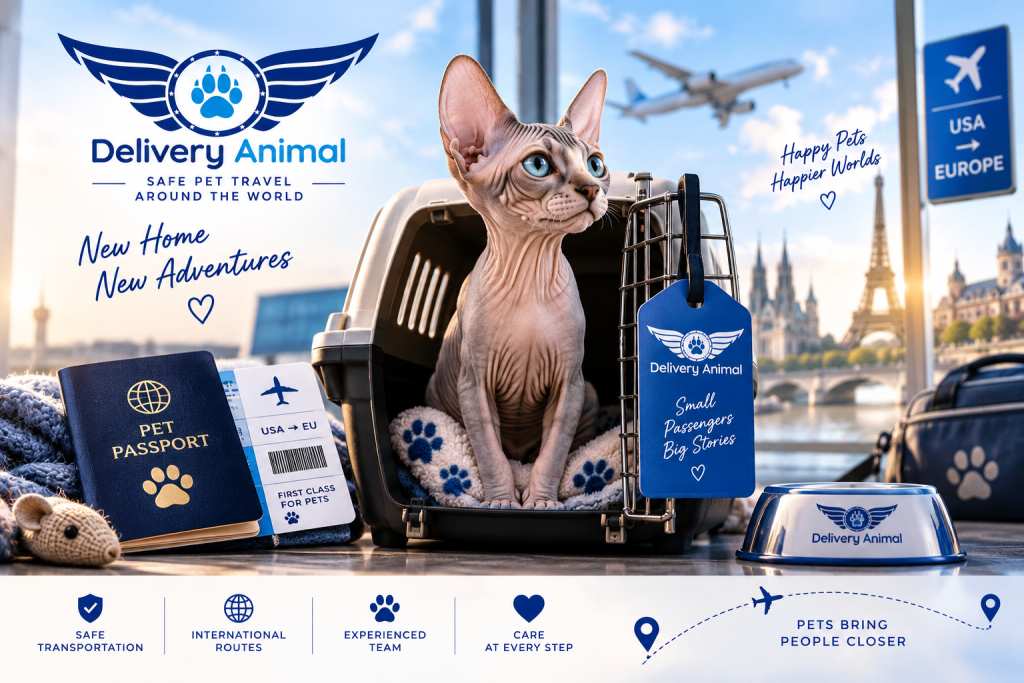

Sphynx Cat Delivery from the USA to Europe
Buying a Sphynx kitten from an American breeder can be an excellent choice for European buyers looking for a specific bloodline, pedigree, color, show quality or breeding potential.
However, moving a kitten from the United States to Europe requires considerably more preparation than simply purchasing an airline ticket.
Sphynx Cat Delivery from the USA to Europe involves veterinary preparation, microchip identification, rabies vaccination, health certificates, airline requirements, route planning and European entry procedures.
The breed also deserves special attention because the Sphynx has little or no conventional fur. Temperature, waiting time and handling conditions therefore become important parts of the transportation plan.
In 2026, travelers must also pay close attention to updated EU veterinary certificate requirements, particularly for shipments taking place during the second half of the year.
Why Sphynx Cat Delivery from the USA to Europe Requires Planning
A long-distance pet shipment may involve several stages:
breeder → ground transportation → airport → flight → transit → European airport → inspection → final delivery.
Every stage has to work correctly.
Before arranging Sphynx Cat Delivery from the USA to Europe, it is important to establish:
- kitten age;
- microchip status;
- rabies vaccination date;
- applicable testing;
- veterinary certificate;
- commercial or non-commercial status;
- airline requirements;
- route;
- European entry airport;
- final delivery arrangements.
International pet transport should therefore be planned as one complete process rather than as a simple flight reservation.
How Old Must a Sphynx Kitten Be to Travel to Europe?
Age is one of the most important factors in Sphynx Cat Delivery from the USA to Europe.
Under EU rules, the primary rabies vaccination can be administered when the cat is at least 12 weeks old. The animal must already be identified by an appropriate microchip, and the required waiting period after a primary vaccination must be completed before travel.
The basic timeline is:
12 weeks → rabies vaccination → waiting period → veterinary certification → travel.
In a standard situation, international transportation is therefore often planned from approximately 15 weeks of age, assuming every other requirement has been fulfilled.
The exact travel date should be calculated from the kitten’s actual birth and vaccination dates.
Microchip Requirements for Sphynx Cats
A microchip is essential for international identification.
For Sphynx Cat Delivery from the USA to Europe, the identification sequence matters.
The general order should be:
microchip → rabies vaccination → documentation → transportation.
The microchip number must match the veterinary records and the health certificate.
An ISO-compatible microchip is generally recommended for international travel.
Before departure, the number should be checked carefully in all documents.
Rabies Vaccination Before Sphynx Cat Delivery from the USA to Europe
Rabies vaccination is one of the key requirements for cats entering the EU from non-EU countries.
The primary vaccination must be administered after the required identification procedure and the applicable waiting period must be completed before travel.
This means that a kitten cannot simply be shipped immediately after reaching the minimum vaccination age.
When planning Sphynx Cat Delivery from the USA to Europe, the veterinary calendar should be established before the final travel date is selected.
Does a Sphynx Need a Rabies Antibody Test?
This depends on the current EU requirements applicable to the country of origin and the specific movement.
The European Commission maintains country lists and explains when rabies antibody titration is required.
For this reason, buyers should not rely on an old checklist found online.
The actual shipment should be checked according to:
country of origin + destination + travel date + movement type.
Documents for Sphynx Cat Delivery from the USA to Europe
The documentation depends on whether the shipment qualifies as commercial or non-commercial.
Depending on the individual case, the documentation package may include:
- animal health certificate;
- microchip information;
- rabies vaccination record;
- laboratory results where applicable;
- veterinary examination;
- owner information;
- declarations;
- breeder documents;
- purchase agreement;
- transportation records;
- airline documentation.
USDA APHIS recommends checking destination-country requirements and working with a USDA-accredited veterinarian for international pet travel.
Correct documentation is particularly important when a kitten is purchased from a breeder and ownership changes.
Buying a Sphynx from a US Breeder
There is an important distinction between taking your own cat on vacation and purchasing a kitten from a breeder.
If an American breeder sells a Sphynx to a buyer in Europe, the kitten is being transferred to a new owner.
That can mean that the shipment falls under commercial movement requirements.
Therefore, Sphynx Cat Delivery from the USA to Europe following a sale should be classified correctly before the health certificate and flight are arranged.
This is one of the most common areas where international pet transportation becomes more complicated.
Can a Sphynx Travel to Europe Without Its Owner?
Depending on the circumstances, a cat may be transported without its owner.
However, the legal classification matters.
EU rules provide specific conditions for certain non-commercial movements involving an authorised person, while a purchased kitten being transferred to a new owner can fall under commercial requirements.
For this reason, professional Sphynx Cat Delivery from the USA to Europe should begin by establishing exactly what type of movement is taking place.
Air Transport for a Sphynx
Once the legal and veterinary requirements are established, the airline and route can be selected.
Cabin travel
Some airlines allow cats to travel in the passenger cabin.
Requirements can include:
- carrier dimensions;
- combined weight;
- advance reservation;
- route restrictions;
- limited pet capacity.
Specialised animal transportation
Some airlines provide dedicated procedures for transporting animals outside the passenger cabin.
Live-animal cargo
For certain international routes, specialised live-animal transportation may be appropriate.
IATA’s Live Animals Regulations provide internationally recognised standards for the safe and humane air transportation of live animals.
Why Temperature Matters for Sphynx Cat Delivery from the USA to Europe
The Sphynx has a unique coat structure, which means temperature deserves special attention.
The transportation chain should be evaluated from beginning to end:
breeder → vehicle → airport → aircraft → transit → European airport → final destination.
A route with an additional cost may be preferable if it reduces unnecessary waiting, outdoor exposure or transfers.
Both cold and excessive heat should be considered when selecting the travel date and route.
Choosing the Right Carrier
The carrier should meet the airline’s current specifications.
The Sphynx should be able to:
- stand naturally;
- turn around;
- lie down comfortably;
- change position.
The carrier should also have:
- adequate ventilation;
- secure locking;
- appropriate dimensions;
- absorbent bedding;
- strong construction.
IATA Live Animals Regulations provide guidance concerning containers and the handling of live animals during air transportation.
Preparing a Sphynx Kitten for an International Flight
Preparation should begin well before departure.
Introduce the carrier
Allow the kitten to explore the carrier at home.
Increase carrier time gradually
Short, positive sessions can help make the carrier familiar.
Practice transportation
If appropriate, short car journeys can help the kitten become accustomed to movement.
Complete veterinary preparation
Check the microchip, rabies vaccination and required documentation.
Confirm the airline
Do not assume that a general airline pet policy applies to every route.
Choosing the Best USA–Europe Route
For Sphynx Cat Delivery from the USA to Europe, the entire route should be evaluated.
Important factors include:
- US departure city;
- European destination;
- direct or connecting flight;
- number of transfers;
- connection duration;
- airline rules;
- seasonal temperature;
- airport handling;
- designated entry point;
- final ground transportation.
A direct flight may reduce handling and travel time.
However, connecting flights can sometimes be necessary because of airline availability and destination restrictions.
The best route is not necessarily the cheapest route.
EU Entry Requirements for Sphynx Cats
Cats entering the EU from non-EU countries may need to enter through a designated Travellers’ Point of Entry where the applicable checks are performed.
This is why the arrival airport should be verified before booking the itinerary.
Choosing an airport simply because it is close to the final destination can create problems if it is not suitable for the relevant animal-entry procedure.
2026 EU Certificate Changes
This is particularly important for Sphynx Cat Delivery from the USA to Europe in autumn 2026.
USDA APHIS has announced updated EU health certificate forms.
The new certificate for non-commercial movement applies from October 1, 2026.
For commercial movements involving dogs, cats and ferrets, the new certificate applies from October 17, 2026.
Therefore, paperwork prepared for a September shipment should not automatically be reused for a November shipment.
The travel date should be established before the final veterinary documentation is prepared.
How Much Does Sphynx Cat Delivery from the USA to Europe Cost?
There is no universal price for international Sphynx transportation.
The final cost depends on:
- departure city;
- destination;
- kitten weight;
- carrier dimensions;
- airline;
- route;
- veterinary services;
- health certificate;
- USDA APHIS endorsement;
- airport charges;
- US ground transportation;
- European ground transportation;
- professional coordination;
- travel date.
A reliable quote for Sphynx Cat Delivery from the USA to Europe therefore requires the details of the individual shipment.
The most useful information is:
origin + destination + approximate weight + preferred travel date.
Sphynx Cat Delivery from the USA to Europe with Delivery Animal
International breeder-to-owner transportation can involve several independent companies and procedures.
Delivery Animal can coordinate the transportation chain:
US breeder → veterinary preparation → documents → airport → airline → Europe → final destination.
This can be especially useful for European buyers who cannot personally travel to the United States to collect their kitten.
Instead of managing each stage separately, the entire journey can be organised as one coordinated international pet-relocation process.
Complete Sphynx Transportation Checklist
Before departure, confirm:
- ✓ Date of birth
- ✓ Microchip
- ✓ Correct microchip number
- ✓ Rabies vaccination
- ✓ Waiting period
- ✓ Rabies antibody test, if applicable
- ✓ Veterinary examination
- ✓ Health certificate
- ✓ USDA APHIS endorsement
- ✓ Commercial/non-commercial classification
- ✓ Breeder documents
- ✓ Purchase documents
- ✓ Airline approval
- ✓ Appropriate carrier
- ✓ Flight route
- ✓ EU entry point
- ✓ Temperature conditions
- ✓ Final delivery arrangements
FAQ: Sphynx Cat Delivery from the USA to Europe
What is the minimum age for a Sphynx to travel to Europe?
A primary rabies vaccination cannot be administered before 12 weeks of age. The required waiting period must then be completed, so standard international travel is often planned from around 15 weeks.
Can a 12-week-old Sphynx enter Europe?
Not simply because it has reached 12 weeks. The kitten must also satisfy the vaccination and waiting-period requirements.
Does a Sphynx need a microchip?
Yes. Proper identification is an essential part of the applicable EU entry requirements.
Can I buy a Sphynx from a US breeder?
Yes. However, a sale or transfer of ownership can affect the legal classification of the shipment.
Can the kitten travel without me?
Potentially, depending on the exact circumstances and movement category.
Can a Sphynx fly in the cabin?
Some airlines permit cabin transportation, but this depends on the specific carrier, route, carrier dimensions and airline policy.
Why is temperature important for Sphynx transportation?
The breed’s lack of a conventional fur coat means that temperature and handling conditions should receive particular attention during international transportation.
Sphynx Cat Delivery from the USA to Europe in 2026: Final Thoughts
A successful international pet relocation begins long before the flight.
The process should follow a clear sequence:
age → microchip → rabies vaccination → waiting period → documentation → movement classification → health certificate → airline → route → EU entry → final delivery.
For autumn 2026 shipments, the introduction of new EU health certificate forms makes advance preparation even more important.
Safe Sphynx Cat Delivery from the USA to Europe is therefore not simply about finding an available flight.
It is about coordinating veterinary requirements, documentation, airline rules, temperature conditions and the complete route around the individual kitten.
With proper planning, the journey can be organised as a controlled international relocation from the American breeder directly to the Sphynx’s new European home.
Official Sources
- European Commission — Bringing a pet into the EU from a non-EU country
- European Commission — Dogs, cats and ferrets
- European Commission — Travellers’ Points of Entry
- USDA APHIS — Pet Travel
- USDA APHIS — Exporting Pets from the United States
- IATA — Live Animals Regulations