
Sweden is one of the European destinations where pet relocation requires careful planning rather than a simple combination of a veterinary passport and an airline ticket. The procedure depends heavily on the country of origin, the rabies status of that country, the route, and whether the animal is travelling with its owner.
Pet Transportation to Sweden from Ukraine, Turkey, the USA, the CIS and other non-EU countries can involve additional veterinary procedures, including rabies antibody testing and an official animal health certificate. Sweden’s competent authority is the Swedish Board of Agriculture (Jordbruksverket), while animals entering Sweden must also be declared to Swedish Customs (Tullverket).
For routes through Central Europe, our related guide to Pet Transportation to Austria can also be useful when planning the first EU entry point.
Pet Transportation to Sweden Starts With the Country of Origin
The first question is not the destination city. It is where the animal is travelling from.
Sweden applies different procedures depending on the rabies situation in the country of origin. Jordbruksverket distinguishes between EU countries, countries where the rabies situation is documented and monitored, and countries where the situation is considered not under control.
This means that:
Germany → Sweden
and
Ukraine → Sweden
are not necessarily prepared in the same way.
Jordbruksverket currently lists Ukraine and Türkiye among the countries where the rabies situation is not considered under control for these purposes.
For this reason, the preparation schedule should be established before the final travel date is booked.
Pet Transportation to Sweden: Microchip Before Rabies Vaccination
Identification is a fundamental part of international pet travel.
The animal must be identified before receiving the rabies vaccination that is being used for the journey. For animals that are ID-marked outside the EU, the applicable identification information should be correctly documented when the animal enters Sweden.
The practical sequence is:
microchip → rabies vaccination → veterinary documents → travel
The identification number should match the veterinary documentation exactly.
After arrival, the same identification information can also be important when the animal is registered and documented in Sweden.
Pet Transportation to Sweden: Rabies Vaccination
For a primary rabies vaccination, the animal must be at least 12 weeks old. After the primary vaccination, at least 21 days must pass before the vaccination can be used for travel under the applicable EU procedure.
This makes the age of puppies and kittens particularly important.
An animal may be old enough to receive the first vaccination but still not be ready for international travel because the required waiting periods have not been completed.
For this reason, the earliest legal travel date should be calculated before a flight is booked.
Pet Transportation to Sweden From Ukraine and Turkey: Rabies Antibody Testing
For animals coming from countries where the rabies situation is not considered under control, Sweden applies additional requirements.
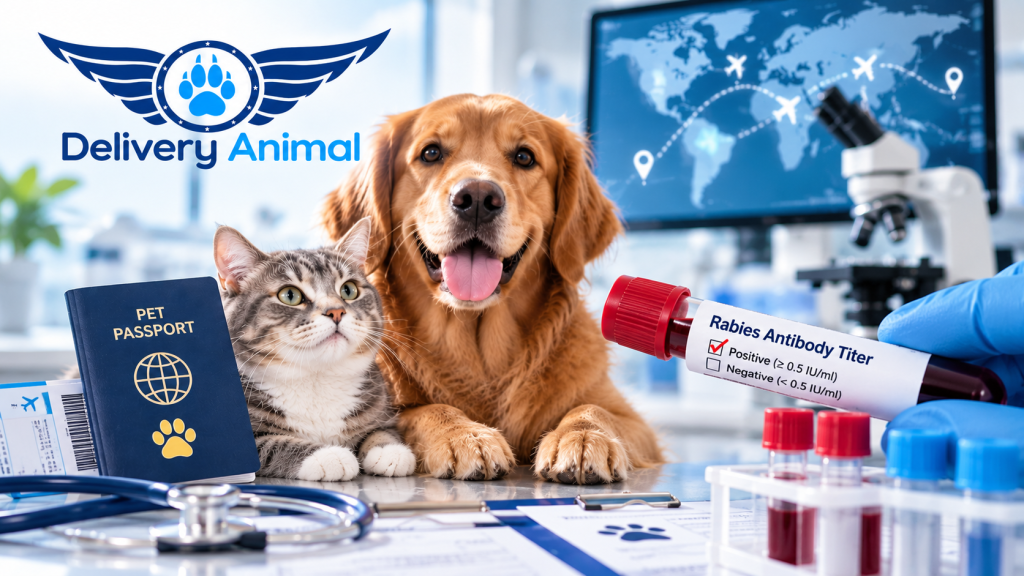
After the primary rabies vaccination, the blood sample for the antibody test is taken after the required period, and the animal must then complete the applicable waiting period before entering the EU. Jordbruksverket explains that this preparation can take up to four months for animals arriving from countries in this category.
This is especially important for routes such as:
Ukraine → Sweden
Türkiye → Sweden
For a pet starting the preparation from zero, the rabies vaccination, antibody test and waiting period need to be calculated as one veterinary timeline.
Pet Transportation to Sweden: When the Titer May Not Need to Be Repeated
There is an important exception for animals that already have a documented vaccination and successful antibody test.
When an EU animal has completed the required rabies vaccination and antibody titration before leaving the EU, and the vaccination has remained continuously valid, certain returning animals can avoid repeating the full waiting procedure.
This can be particularly important for owners who temporarily live outside the EU and later return to Sweden.
Keeping the original pet passport and laboratory documentation is therefore extremely important.
Pet Transportation to Sweden: The Animal Health Certificate
When a pet comes from a non-EU country, an official Animal Health Certificate may be required instead of an ordinary foreign veterinary passport.
Jordbruksverket provides different certificate procedures depending on whether the animal is travelling with its owner, travelling alone, changing owner, or being transported as part of a larger group.
This distinction matters because a dog travelling with its owner is not automatically subject to the same procedure as a dog shipped separately as cargo.
The certificate must correspond to the actual movement and the animal’s veterinary history.
Pet Transportation to Sweden: Entering Through Another EU Country
A route through another EU Member State can be completely legitimate, but the first EU entry point becomes part of the veterinary procedure.
For example:
Ukraine → Poland → Sweden
If the animal enters the EU through Poland, the relevant checks must be completed at the appropriate EU entry point before the pet continues to Sweden. Jordbruksverket warns that the necessary confirmation of the entry checks must be correctly documented.
Therefore, Poland, Germany or another EU country cannot simply be treated as a casual transit stop.
The first EU border crossing should be selected together with the veterinary documentation.
For more information about European routes, see our article Pet Transportation from Turkey to Europe.
Pet Transportation to Sweden: Direct Entry From a Non-EU Country
When a pet enters Sweden directly from outside the EU, the applicable airport and border procedures matter.
Jordbruksverket identifies Arlanda Airport in Stockholm and Landvetter Airport in Gothenburg for direct entry for the relevant categories of pets coming from outside the EU.
This means that the closest airport to the final home address is not necessarily the correct airport for the pet.
A route may therefore look like:
non-EU country → Stockholm → ground delivery to another Swedish city
instead of flying directly to the nearest regional airport.
Pet Transportation to Sweden: Ground Transportation
Ground transportation can be a practical option after the pet has completed the required EU entry procedures.
It is particularly useful for:
- large dogs;
- several pets travelling together;
- animals that do not tolerate multiple flights well;
- owners who prefer door-to-door transportation.
For example:
Poland → Sweden
or
Germany → Sweden
may be organized as the final road section of a longer international relocation.
The main advantage is the reduction in additional flights and airport transfers.
Pet Transportation to Sweden: Is Deworming Required?
Sweden has an interesting difference from some European destinations.
There is no mandatory deworming requirement for dogs and cats entering Sweden against the fox tapeworm (Echinococcus multilocularis), because the parasite is already present in Sweden. However, Jordbruksverket recommends preventive treatment before travel.
This is a good example of why requirements should be checked for the specific destination rather than copied from another European country.
Pet Transportation to Sweden: More Than Five Animals
Ordinary non-commercial pet travel generally covers a maximum of five dogs, cats or ferrets.
Different procedures can apply to groups of more than five animals, animals travelling without their owner, and animals that will be sold, rehomed, adopted or otherwise change ownership after entry.
This distinction is particularly important for:
- breeders;
- rescue organizations;
- professional pet transport companies;
- shelters;
- families travelling with several animals.
A shipment of three family pets and a shipment of eight dogs cannot automatically be handled under the same procedure.
Pet Transportation to Sweden: Cargo and Unaccompanied Pets
A pet travelling without its owner requires additional planning.
Jordbruksverket has separate procedures for animals travelling alone, including situations where the animal is transported as cargo or will change owner after arrival.
This means that cargo transportation should be arranged together with the veterinary and border documentation.
Before booking, determine:
- who books the cargo;
- who will meet the animal;
- where the veterinary inspection takes place;
- which documents accompany the shipment;
- how the animal reaches its final address.
The airline ticket is only one part of the logistics.
Pet Transportation to Sweden: Customs Declaration
After dealing with veterinary requirements, there is another mandatory step: Swedish Customs.
Tullverket states that every dog or cat entering Sweden must be declared to Swedish Customs. Animals arriving from a non-EU country must be declared at the border, including when the pet is transported as cargo.
Online registration is available only in specific cases involving travellers living in the EU, travelling from another EU country and carrying an EU pet passport. It is not available for animals arriving from non-EU countries.
Failing to declare the animal can constitute an offence.
Pet Transportation to Sweden: After Arrival
The international journey does not necessarily end when the pet leaves the airport.
Owners should also check whether Swedish registration or other national procedures apply after arrival.
For example, when bringing an imported dog into Sweden, Swedish rules can require additional registration in the national system and contact with a veterinarian. The exact post-arrival procedure depends on the circumstances of the import.
This is why professional relocation should be planned from the original country all the way to the final Swedish address.
Pet Transportation to Sweden: Planning the Whole Route
A reliable international route can be built in the following order:
1. Identify the country of origin.
2. Determine its rabies-risk category.
3. Check the microchip and vaccination history.
4. Determine whether rabies antibody testing is required.
5. Calculate the waiting period.
6. Select the first EU entry point.
7. Confirm the airline and transit route.
8. Prepare the official veterinary certificate.
9. Arrange customs declaration.
10. Organize the final delivery in Sweden.
This approach is much safer than booking transportation first and trying to solve the paperwork afterward.
Pet Transportation to Sweden With Delivery Animal
Delivery Animal helps coordinate international transportation of dogs and cats to Sweden from Ukraine, Türkiye, the USA, Europe, Kazakhstan and other countries.
Depending on the route, the service can include:
- country-of-origin assessment;
- microchip verification;
- rabies vaccination planning;
- antibody titration;
- veterinary certificates;
- EU entry-point planning;
- TRACES/CHED arrangements where applicable;
- air transportation;
- cargo;
- ground transportation;
- transit planning;
- transport crate preparation;
- customs coordination;
- delivery to the final Swedish address.
For Central European routes, our related article Pet Transportation to Austria may also be useful.
For Switzerland-related routes, see Pet Transportation to Switzerland.
For transportation from Türkiye, see Pet Transportation from Turkey to Europe.
Expert Conclusion
Pet Transportation to Sweden in 2026 should be planned according to the animal’s country of origin, rabies-risk category and complete route: pets from countries such as Ukraine and Türkiye may require a substantially longer preparation process, including rabies antibody testing and the applicable waiting period, while animals arriving from non-EU countries must also be declared to Swedish Customs; the current requirements should always be verified directly with the Swedish Board of Agriculture — Jordbruksverket.
Delivery Animal can coordinate the complete relocation process — from veterinary preparation and route planning to border formalities and delivery of the dog or cat to its final address in Sweden.