
Switzerland is a particularly interesting destination for international pet relocation. It is not a member of the European Union, but Switzerland and the EU have agreements that closely coordinate certain veterinary rules for dogs, cats and ferrets. At the same time, Switzerland maintains its own border-control procedures and national restrictions.
For this reason, Pet Transportation to Switzerland should be planned according to the animal’s country of origin, rabies status, route, method of transportation and point of entry.
The Swiss Federal Food Safety and Veterinary Office (FSVO / BLV) recommends checking the official requirements before every journey because temporary disease-control restrictions can take precedence over the normal import rules.
Pet Transportation to Switzerland: The Country of Origin Comes First
The first question is not the Swiss destination city. It is where the pet is travelling from.
The requirements for a dog or cat travelling from Germany are different from those for an animal coming directly from Ukraine, Turkey, the USA or another third country.
For Switzerland, third countries are countries outside the EU, Northern Ireland, Iceland and Norway under the applicable animal-import framework.
This makes the following routes legally different:
Germany → Switzerland
Ukraine → Switzerland
Turkey → Switzerland
USA → Switzerland
A route involving an EU transit country must also be evaluated as a complete journey rather than as separate flights.
Pet Transportation to Switzerland: Microchip Before Rabies Vaccination
Dogs, cats and ferrets entering Switzerland from abroad must be correctly identified.
For the standard procedure, the microchip must be implanted before the rabies vaccination used for the journey. The animal’s identification number should correspond exactly with the veterinary documentation.
Before departure, it is worth checking the complete chain:
microchip → rabies vaccination → veterinary records → certificate → travel
A mismatch in the microchip number can cause problems during border inspection.
Pet Transportation to Switzerland: Rabies Vaccination
A valid rabies vaccination is a fundamental requirement for international pet travel.
The first vaccination may be administered from 12 weeks of age. It becomes valid for travel only after the applicable waiting period, generally 21 days after the primary vaccination. The vaccination must be given after the animal has been identified.
This makes young puppies and kittens particularly sensitive to the timing of the preparation.
The owner should not calculate the trip simply by the animal’s age. The vaccination date and waiting period must also be included.
Pet Transportation to Switzerland: When Is a Rabies Titer Required?
This is one of the most important differences between international routes.
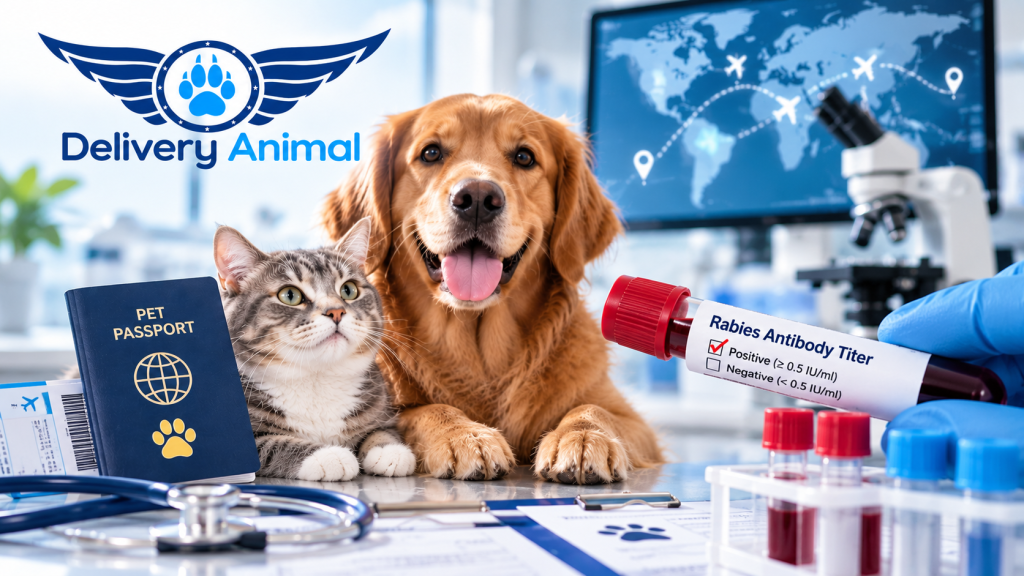
Switzerland distinguishes between countries with low rabies risk and countries classified as rabies-risk countries. For animals arriving from a rabies-risk country, additional requirements apply, including a rabies antibody titration testand longer waiting periods.
The test must be performed by a recognized laboratory, and the applicable vaccination, blood-sampling and waiting periods must be respected.
The practical consequence is significant: Switzerland does not allow dogs, cats and ferrets under seven months of ageto enter from rabies-risk countries under this procedure.
Therefore, when transporting a young animal internationally, the earliest possible legal arrival date should be calculated before booking the trip.
Pet Transportation to Switzerland: Direct Air Entry From a Rabies-Risk Country
There is another important Swiss requirement for certain routes.
When a pet from a rabies-risk country enters Switzerland directly by air, an FSVO import permit is additionally required.
This makes these two itineraries potentially very different:
Turkey → Zurich → Switzerland
and
Turkey → EU → Switzerland
The correct procedure depends on the exact country classification, transportation method and transit arrangements.
A route should therefore be verified before tickets are purchased.
Pet Transportation to Switzerland: Veterinary Certificate
When a dog, cat or ferret arrives from a third country, the applicable official veterinary certificate must accompany the animal.
The FSVO provides an official model Veterinary Certificate and Additional Documents for non-commercial movements of pet dogs, cats and ferrets for relevant international journeys.
The certificate and supporting documents must correspond to:
- the animal’s identification;
- rabies vaccination;
- antibody testing where required;
- the owner’s information;
- the specific non-commercial movement.
A regular private veterinary passport should not automatically be treated as the complete international document package for a third-country route.
Pet Transportation to Switzerland: First Entry and Border Veterinary Control
When a border veterinary inspection is required, the Swiss Border Veterinary Service carries out checks at designated border-control locations.
The FSVO identifies Zurich and Geneva airports for these checks. Switzerland also has an agreement with the EU under which veterinary border controls carried out at an EU border-control post can be recognized in Switzerland, and vice versa.
This creates important routing possibilities.
For example, depending on the applicable procedure:
Ukraine → EU → Switzerland
may be operationally different from:
Ukraine → Zurich → Switzerland
The correct first point of veterinary control should be determined before the itinerary is finalized.
Pet Transportation to Switzerland: Travelling Through the EU
A pet may travel to Switzerland through an EU country, but this does not automatically eliminate the requirements applicable to the original country of departure.
The entire journey must be compliant.
For owners planning transportation from Turkey, our related article Pet Transportation from Turkey to Europe can be useful when designing the first stage of a combined route.
For a Central European itinerary, Pet Transportation to Austria also provides useful information about EU entry procedures before continuing to Switzerland.
Pet Transportation to Switzerland: Air or Ground Transportation?
The best transportation method depends on the animal rather than the destination alone.
For a small dog or cat, air travel may be practical, provided the airline accepts the animal.
For a large dog, ground transportation may be more comfortable after the pet has completed the required veterinary entry procedures.
Ground routes can be particularly useful between:
Germany → Switzerland
Austria → Switzerland
France → Switzerland
Italy → Switzerland
The route should always be checked against the applicable border and customs requirements.
Pet Transportation to Switzerland: Animals Travelling Without Their Owner
Switzerland allows unaccompanied pet entry in certain circumstances, but the procedure is different.
According to the FSVO, an unaccompanied pet must enter by air freight. The airline issues an Air Waybill (AWB), and the animal is taken to the animal facility in the airport’s freight area after arrival. The airline is responsible for arranging this procedure.
This option involves additional time and cost.
The owner should determine in advance:
- who is responsible for the cargo booking;
- who will receive the animal;
- which documents are needed;
- where the veterinary inspection takes place;
- who completes the customs procedure;
- how the pet is transported after airport release.
Pet Transportation to Switzerland: Zurich and Geneva
If a border veterinary inspection is required and the animal is arriving by air, the choice of airport becomes particularly important.
The FSVO identifies Zurich and Geneva as the Swiss airports where the Border Veterinary Service carries out the relevant controls for third-country imports.
For this reason, the most convenient airport for the owner is not necessarily the correct airport for the animal.
The destination city may be Basel, Bern, Lausanne, Lucerne or another Swiss location, while the pet’s veterinary entry point may be Zurich or Geneva.
Pet Transportation to Switzerland: Five-Pet Rule
The standard non-commercial rules allow a maximum of five dogs, cats or ferrets under the relevant pet-travel conditions.
More than five animals generally fall under commercial-import requirements unless a specific exception applies, such as certain exhibitions or sporting events.
This distinction matters for:
- breeders;
- rescue organizations;
- professional transport companies;
- families relocating with several pets.
Six animals should therefore not simply be treated as an ordinary extension of a five-pet private journey.
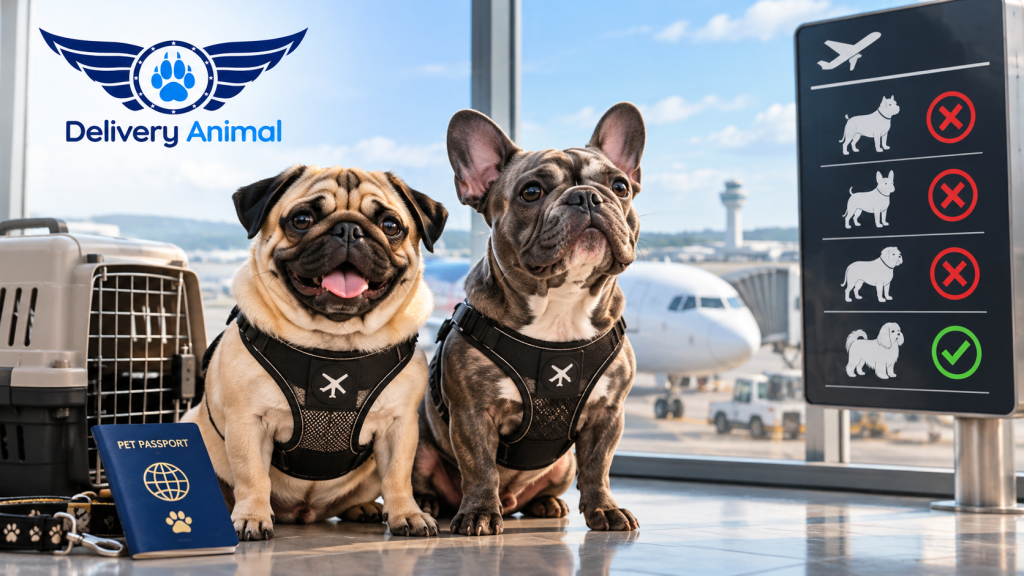
Pet Transportation to Switzerland: Docked Tails and Cropped Ears
Switzerland has a national restriction that is particularly important for international relocation.
The import of dogs with cropped ears and/or docked tails is prohibited. The FSVO specifically highlights this restriction in its current pet-travel guidance.
Owners of affected dogs should establish whether the animal can legally enter Switzerland before paying for transportation.
This requirement is separate from ordinary vaccination and veterinary-document rules.
Pet Transportation to Switzerland: Protected and Hybrid Animals
Additional rules apply to protected species and certain hybrid animals.
For example, CITES requirements may apply to wild-cat hybrids, wolf hybrids and other protected species. The FSVO recommends checking the applicable species-conservation rules before travel.
A Bengal or Savannah cat, for example, should not automatically be treated like an ordinary domestic cat simply because it lives as a pet.
Pet Transportation to Switzerland: What Happens After Arrival?
The process does not necessarily end when the animal leaves the airport.
For imported dogs, Switzerland requires additional national steps after arrival. The FSVO states that an imported dog must be registered and brought to a veterinarian within 10 days of importation, with registration in the Swiss Amicusdatabase.
This is an important difference between simply entering Switzerland with a pet and completing the relocation process properly.
The owner should therefore plan both:
border entry → post-arrival Swiss registration
rather than stopping the preparation at the airport.
Pet Transportation to Switzerland: Temporary Disease Restrictions
Normal import requirements are not always the only requirements.
If an animal disease outbreak creates a health risk, Switzerland can introduce temporary protective measures or import bans for particular countries or regions.
The FSVO states that these protective measures take precedence over ordinary import conditions and may also apply to permits that have already been issued.
This is why the official Swiss requirements should be checked again immediately before departure.
Pet Transportation to Switzerland With Delivery Animal
Delivery Animal helps coordinate international pet relocation to Switzerland from Ukraine, Turkey, the USA, Kazakhstan, Europe and other countries.
Depending on the route, assistance can include:
- country-of-origin assessment;
- microchip and vaccination verification;
- rabies antibody titration;
- FSVO import-permit coordination where required;
- veterinary certificate preparation;
- first-point-of-entry planning;
- airline booking;
- cargo transportation;
- transit through the EU;
- ground transportation;
- travel-crate selection;
- airport collection;
- delivery to the final Swiss address.
Expert Conclusion
Pet Transportation to Switzerland should begin with the country-of-origin classification, because dogs, cats and ferrets from rabies-risk countries face additional requirements, including antibody testing and longer waiting periods, while direct air entry from such a country can also require an FSVO import permit; before confirming the route, owners should verify the current official requirements through the Swiss FSVO Travel Check for dogs, cats and ferrets.
Switzerland also has several national details that should not be overlooked, including border veterinary checks, restrictions on dogs with cropped ears or docked tails, special procedures for unaccompanied air-freight animals and post-arrival requirements for imported dogs.
Delivery Animal coordinates the complete international relocation process — from veterinary preparation and route planning to border procedures and delivery of the dog or cat to its final address in Switzerland.