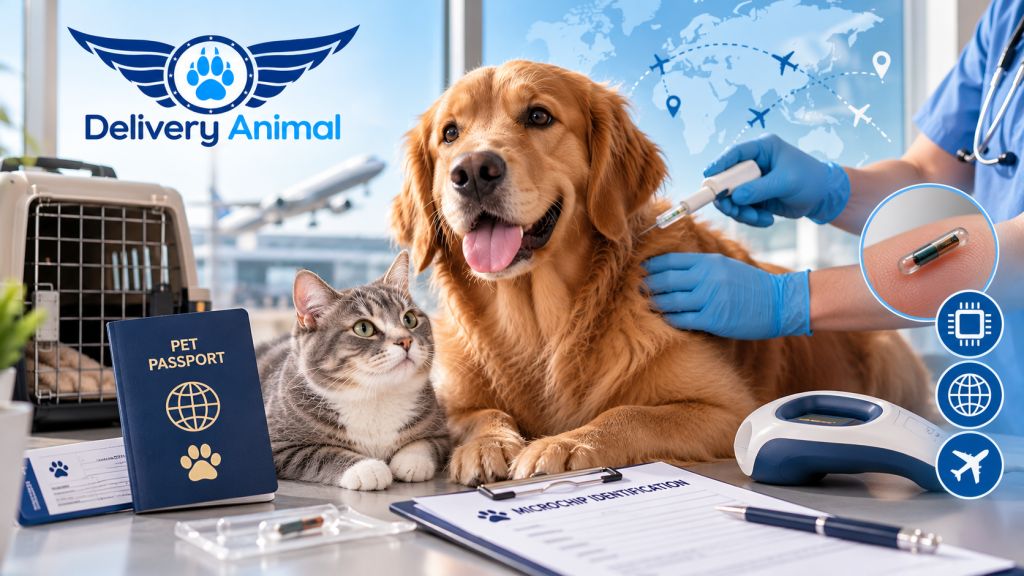

A Microchip for a Dog or Cat is one of the most important identification tools used when preparing a pet for international travel.
A microchip is not simply a way to identify a lost animal. During international transportation, it can connect the pet with its:
- veterinary passport;
- rabies vaccination;
- health certificate;
- laboratory test results;
- import documents;
- owner information.
For many international routes, the Microchip for a Dog or Cat is also directly connected to the validity of the rabies vaccination.
This means that the timing of microchipping can be extremely important.
For example, EU rules require the animal to be identified before the primary rabies vaccination. The date of vaccination must not precede the date of identification.
Therefore, if you are planning international pet transportation, microchipping should be considered at the beginning of the veterinary preparation process.
Is a Microchip for a Dog or Cat Required for International Travel?
There is no single rule that applies to every country.
Each destination establishes its own import requirements, and airlines can have additional requirements.
However, many countries require dogs, cats and ferrets to be individually identified with a microchip.
A Microchip for a Dog or Cat is particularly important for travel to destinations where the identification number must be connected to the rabies vaccination and official veterinary documents.
Before booking a flight, check:
- the destination country’s requirements;
- transit-country requirements;
- airline requirements;
- the animal’s vaccination history;
- the microchip standard;
- the date the microchip was implanted.
USDA APHIS also recommends checking the requirements of the destination country well in advance because international pet travel preparation can involve several veterinary and documentary steps.
What Type of Microchip Does a Dog or Cat Need in 2026?
For international travel, an ISO-compatible microchip is commonly used.
The relevant standards are:
- ISO 11784
- ISO 11785
Many international microchips use a 15-digit identification number.
When choosing a Microchip for a Dog or Cat, the important question is not simply whether the chip works locally. It must also be suitable for the destination country and readable by the scanners used during official checks.
For some destinations, ISO compatibility is specifically required.
This is particularly important if the animal already has an older microchip.
How Many Digits Does a Pet Microchip Have?
Many internationally compatible microchips have a 15-digit identification number.
The number should be recorded accurately in the pet’s official documents.
After implantation, the veterinarian should check that:
- the microchip can be scanned;
- the identification number is correct;
- the number is entered correctly in the veterinary passport;
- the number matches other travel documents;
- the microchip meets the requirements of the destination.
A single incorrect digit can create a discrepancy between the animal and its documentation.
That is why the number associated with the Microchip for a Dog or Cat should always be checked before international travel.
When Should a Microchip Be Implanted?
If a dog or cat is being prepared for international travel, the microchip should generally be implanted before the primary rabies vaccination whenever the destination requires this sequence.
A typical preparation sequence may look like this:
Microchip → rabies vaccination → waiting period → additional testing → health certificate → travel
This sequence is particularly important for travel to the European Union.
EU requirements state that the date of identification must precede the date of the primary rabies vaccination.
Therefore, if the rabies vaccine was administered first and the microchip was implanted afterward, the vaccination may not meet the requirements for certain international routes.
Can a Microchip Be Implanted After Rabies Vaccination?
For domestic purposes, microchipping and vaccination may be performed at different times.
International travel is different.
If the destination requires the animal to be identified before its primary rabies vaccination, implanting a Microchip for a Dog or Cat after that vaccination can create a documentation problem.
In some situations, the vaccination may need to be repeated after proper identification.
This is why it is safer to establish the requirements of the destination before starting the veterinary preparation.
What Should Be Done After Microchipping?
After the Microchip for a Dog or Cat is implanted, the veterinarian should scan it and confirm the identification number.
The number should then be correctly connected to the pet’s documents.
Check that:
- the chip can be scanned;
- the number is recorded correctly;
- the number appears in the veterinary passport;
- owner information is accurate;
- the date of implantation is recorded where required;
- the number can be included in the international health certificate.
For EU travel, the animal health certificate includes identification information, including the microchip identification code.
Does a Microchip Need to Be Registered?
Implanting a microchip and registering its number are not always the same process.
The microchip itself contains an identification number, while owner information may be stored in a separate database.
After implantation, ask the veterinary clinic:
- Which database contains the microchip information?
- Has the owner’s information been registered?
- How can the contact information be updated?
- Can the registration be transferred if the owner moves?
- Does the microchip number match the veterinary passport?
Keeping contact information updated is especially important after an international relocation.
What If the Dog or Cat Already Has a Microchip?
Do not automatically implant another microchip.
First, have the existing Microchip for a Dog or Cat scanned and verified.
Check:
number → readability → standard → documentation → destination requirements
If the existing microchip is compatible with the destination’s requirements, there may be no reason to replace it.
If it is not compatible, additional identification may sometimes be necessary.
For example, USDA APHIS guidance for travel to Great Britain explains that animals with non-ISO-compatible microchips may require an appropriate scanner or an additional compatible microchip, with the identification information properly documented.
Can a Dog or Cat Have Two Microchips?
In certain situations, an animal can have more than one microchip.
This may happen when an existing microchip is not compatible with the requirements of the destination country.
However, this should not be done simply as a precaution.
A veterinarian should first:
- scan the existing chip;
- record the identification number;
- determine whether it meets the destination requirements;
- check whether the scanner can read it;
- decide whether additional identification is necessary.
If two microchips are present, both numbers may need to be correctly documented.
Microchip and Rabies Vaccination
One of the most important relationships in international pet transportation is:
microchip + rabies vaccination + official documentation
The microchip identifies the individual animal.
The rabies vaccination provides evidence of vaccination status.
The veterinary documents connect these two pieces of information.
The process can therefore be viewed as:
Microchip → identification number → rabies vaccination → veterinary passport → health certificate → border inspection
If the number in the passport does not match the number detected by the scanner, the authorities may question whether the vaccination documents belong to that specific animal.
This is why checking the Microchip for a Dog or Cat before departure is so important.
Microchip and Rabies Antibody Testing
Some international routes require a rabies antibody test.
In these cases, the animal’s identification is particularly important because the laboratory result must be linked to the correct animal.
A preparation process may look like:
Microchip → rabies vaccination → required waiting period → blood sample → laboratory testing → additional waiting period → travel
If the microchip number is entered incorrectly on the laboratory documentation, it can create complications with the travel documentation.
Therefore, the Microchip for a Dog or Cat should be verified before the blood sample is taken.
Microchip for a Dog or Cat When Traveling to Europe
The European Union has specific identification requirements for dogs, cats and ferrets.
For relevant movements into the EU, animals must be individually identified, and the identification must be linked to the animal’s veterinary documentation.
The microchip must be implanted before the primary rabies vaccination under the applicable EU rules.
Before traveling to Europe, check:
- microchip type;
- microchip number;
- date of implantation;
- readability;
- rabies vaccination date;
- veterinary certificate;
- additional testing requirements;
- country-specific entry conditions.
Do not rely on an old checklist because EU pet travel requirements can change.
Microchip for a Dog or Cat When Traveling to Great Britain
Great Britain has specific requirements for the identification of dogs, cats and ferrets.
An ISO-compatible microchip is required.
If the existing microchip cannot be read by an appropriate scanner, additional arrangements may be necessary.
The microchip information must also be correctly reflected in the animal’s documentation.
Therefore, if you are planning to transport a Microchip for a Dog or Cat to Great Britain, check the current requirements before booking the trip.
Microchip for a Dog or Cat When Traveling to the USA
The United States does not have one universal microchip rule that applies identically to every international pet movement.
Requirements depend on the type of animal, origin, destination and applicable federal rules.
For dogs entering the United States, CDC requirements are particularly important, while USDA APHIS may also have separate animal-health requirements depending on the circumstances.
Therefore, the Microchip for a Dog or Cat should be checked as part of the complete U.S. import process rather than treated as a separate requirement.
The exact requirements should be verified according to the dog’s country of origin and recent travel history.
Does a Puppy or Kitten Need a Microchip?
Young animals require special attention because microchip requirements can be connected with minimum vaccination ages and waiting periods.
For example, EU rules establish a minimum age for the primary rabies vaccination and require identification before that vaccination.
This means that transporting a puppy or kitten internationally cannot be planned based only on its current age.
You need to calculate:
age → microchip → rabies vaccination → waiting period → additional requirements → earliest possible travel date
Different countries may apply different rules.
What If the Microchip Cannot Be Read?
If a scanner cannot detect the microchip, the animal should be examined by a veterinarian.
Possible causes include:
- microchip malfunction;
- scanner incompatibility;
- technical problems;
- migration of the microchip;
- incorrect documentation;
- incompatible microchip frequency.
Do not immediately implant another chip without checking the existing one.
The veterinarian should determine what happened and document the animal’s identification correctly.
How to Check the Microchip Before International Travel
A final microchip check should be part of the pre-travel preparation.
Verify that:
☑ the chip can be scanned;
☑ the identification number is correct;
☑ the number matches the veterinary passport;
☑ the number matches the health certificate;
☑ the implantation date is correctly documented;
☑ the chip meets the destination country’s requirements;
☑ the owner information is current;
☑ the transit country has no additional identification requirements.
This simple check can prevent serious problems during border or airport inspection.
7 Common Microchip Mistakes
1. Vaccinating Before Microchipping
For some destinations, this can break the required sequence.
2. Choosing a Microchip Without Checking the Destination
Not every chip is automatically suitable for every country.
3. Writing the Number Incorrectly
One wrong digit can create a discrepancy between the pet and its documents.
4. Never Scanning the Chip Again
A pre-travel scan is a useful final verification.
5. Failing to Record the Chip Number
The identification number should be correctly connected to the pet’s official documentation.
6. Ignoring Transit Countries
Transit requirements can affect the overall travel documentation.
7. Using Outdated Information
International pet travel regulations can change, so current official requirements should always be checked.
Microchip for a Dog or Cat — International Travel Checklist
Before departure, check:
☐ Microchip implanted
☐ Microchip can be scanned
☐ Identification number recorded correctly
☐ Microchip standard confirmed
☐ Implantation date documented
☐ Microchip implanted before rabies vaccination when required
☐ Microchip number entered in the veterinary passport
☐ Microchip number included in required certificates
☐ Owner information updated
☐ Destination requirements checked
☐ Transit requirements checked
☐ Airline requirements checked
When Should You Start Preparing the Microchip?
International pet transportation should be planned well in advance.
USDA APHIS recommends starting the preparation process early because destination requirements can involve several veterinary procedures and documentation steps.
A practical planning sequence is:
Destination → transit → requirements → microchip → rabies vaccination → testing → certificates → airline booking → travel
This approach is much safer than buying a ticket first and checking the veterinary requirements afterward.
How Delivery Animal Helps With Microchip and Travel Documents
A Microchip for a Dog or Cat is only one part of international pet relocation.
Delivery Animal can help coordinate the complete preparation process, including:
- destination requirements;
- microchip requirements;
- vaccination planning;
- rabies antibody testing;
- veterinary certificates;
- import permits;
- transit requirements;
- airline documentation;
- international transportation logistics.
This is especially useful for complex routes involving several countries or long transit connections.
If you are planning to move a dog or cat abroad, the correct microchip and the correct timing of vaccination should be established before the veterinary preparation begins.
FAQ — Microchip for a Dog or Cat
Is a microchip required for international pet travel?
Many countries require dogs and cats to be individually identified with a microchip, but the exact requirements depend on the destination.
What type of microchip is used for international travel?
ISO-compatible microchips meeting ISO 11784/11785 are commonly used for international pet travel.
Should the microchip be implanted before the rabies vaccination?
For many routes, yes. EU rules require identification before the primary rabies vaccination.
Can a pet have two microchips?
Yes, this can be necessary in some situations when the original chip is not compatible with the destination’s requirements. A veterinarian should determine whether an additional chip is needed.
Does the microchip number need to be in the pet passport?
The microchip number should be correctly connected to the animal’s official veterinary documentation.
What happens if the microchip number is different in the passport?
The discrepancy should be corrected before travel. Do not wait until the airport or border inspection.
Is a microchip required for travel to Europe?
For relevant EU movements involving dogs, cats and ferrets, individual identification by microchip is required under the applicable rules.
Does a dog need a microchip to enter the USA?
U.S. requirements depend on the animal’s circumstances and applicable federal rules. The microchip should be checked together with the current CDC and USDA APHIS requirements for the specific route.
How long before travel should a pet be microchipped?
There is no single worldwide timeframe. The timing depends on the destination and the relationship between identification, rabies vaccination and other required procedures.
Expert Conclusion
A Microchip for a Dog or Cat is much more than a small identification device when an animal is traveling internationally.
It can determine whether the rabies vaccination is recognized, whether laboratory results can be linked to the correct animal and whether the official veterinary documents match the pet being presented at the border.
The safest preparation sequence is:
check the destination requirements → implant the correct microchip → vaccinate against rabies → complete additional tests if required → prepare certificates → verify all identification numbers → travel.
Never assume that the rules used for one country will automatically apply to another.
If you are planning international transportation for your dog or cat, Delivery Animal can help organize the documentation and logistics according to the specific route.
Official Sources
- European Commission — Entry into the Union: Dogs, Cats and Ferrets
- European Commission — Bringing a Pet into the EU from a Non-EU Country
- EUR-Lex — EU Rules on Identification of Dogs, Cats and Ferrets
- USDA APHIS — Pet Travel Process Overview
- USDA APHIS — Frequently Asked Questions About Traveling With Your Pet
- USDA APHIS — Pet Travel to Great Britain
- USDA APHIS — Pet Travel