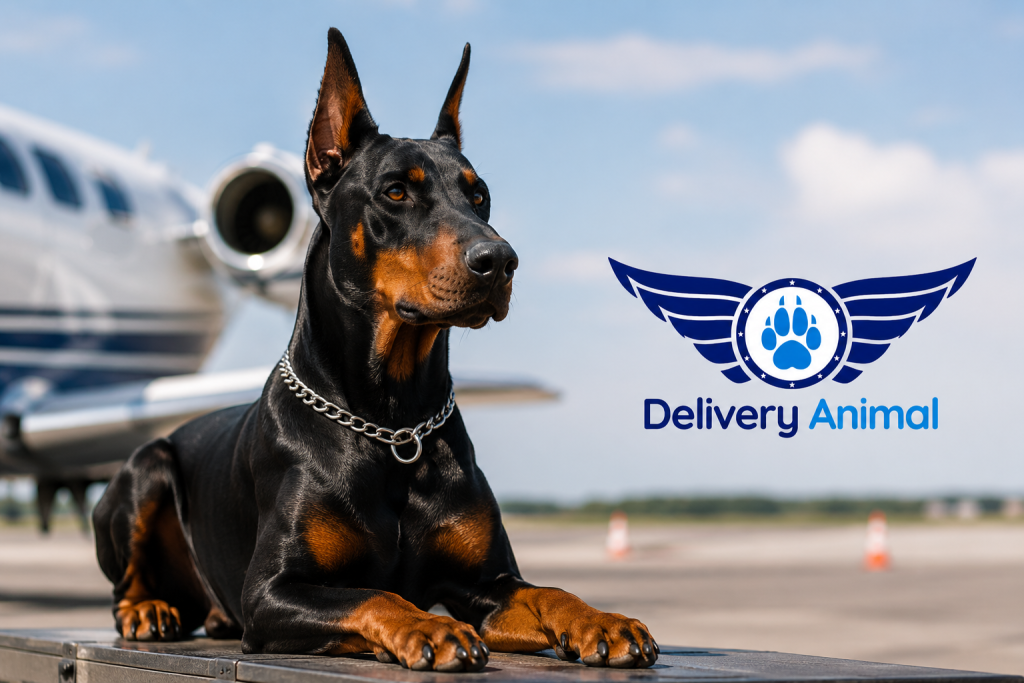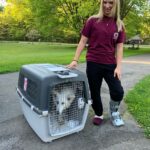

The Doberman is one of the best-known working dog breeds, combining elegant conformation, physical strength, high trainability, and pronounced working ability. However, the professional selection of a puppy or adult dog requires a much deeper analysis than simply reviewing photographs, pedigrees, or the number of show titles.
Today, a Doberman with worldwide delivery can be purchased from specialized kennels in Europe and other regions. Buyers can choose from puppies, promising young dogs, breeding prospects, show dogs, and trained working dogs.
When selecting a dog, it is important to analyze its origin, the health of the parents, working certificates, breed test results, conformation, temperament, and the quality of the specific bloodline combination.
Delivery Animal helps organize the international selection and transportation of dogs from foreign kennels. Clients can receive support throughout the main stages of the process, from document verification and preparing the animal for travel to meeting veterinary requirements and arranging an international transport route.
Why Is a Doberman with Worldwide Delivery Highly Valued?
The Doberman was developed as a functional working dog. Historically, representatives of the breed were used for protection, accompanying people, and performing various service tasks.
A modern Doberman should preserve not only the characteristic appearance of the breed but also the qualities developed throughout its history.
Dobermans are valued for their high trainability, strong bond with their owners, physical endurance, quick reactions, and ability to participate in various types of training and dog sports.
However, the professional value of a dog is determined by a combination of characteristics.
A high-quality representative of the breed should combine functional conformation, a stable temperament, good health, and pronounced working abilities.
That is why a Doberman with worldwide delivery should always be selected according to the future owner’s goals.
The selection criteria for a family companion, promising breeding dog, show prospect, or sporting Doberman may differ significantly.
Working Certificates: How to Choose a Doberman with Worldwide Delivery
Working ability cannot be objectively evaluated solely through photographs or famous names in a pedigree.
Official working trials are used to assess the training and abilities of dogs.
One of the best-known international systems is FCI-IGP.
The trials include three disciplines:
- tracking;
- obedience;
- protection work.
There are three progressive levels: FCI-IGP 1, FCI-IGP 2, and FCI-IGP 3.
As the level increases, the exercises become more difficult and the requirements for both the dog and handler become higher.
A working certificate confirms that the dog has completed the required trial program.
However, a professional evaluation should not be limited to checking whether the letters IGP appear in a pedigree.
The scores obtained, quality of performance, consistency of results, and level of competition should also be considered.
When purchasing a Doberman with worldwide delivery, it is advisable to examine the working achievements of not only the puppy’s parents but also other close relatives.
This provides a more objective understanding of the working potential of a particular bloodline.
BH/VT and Basic Doberman Training
Before participating in higher-level trials, dogs may complete the BH/VT test.
The examination evaluates basic obedience and the dog’s behavior in different environmental situations.
A BH/VT qualification indicates that the dog has undergone systematic training and has been evaluated for its ability to cooperate with the handler.
However, the certificate alone does not guarantee a stable temperament.
Confidence, controllability, concentration on the handler, and appropriate reactions to environmental stimuli are particularly important qualities for a Doberman.
Excessive nervousness, uncontrolled excitement, or aggression should not be considered signs of a strong temperament.
IGP 1, IGP 2, and IGP 3: The Importance of Working Titles
IGP 1 is the first full level of the FCI-IGP system.
The dog must successfully complete the tracking, obedience, and protection phases.
IGP 2 introduces more demanding exercises.
IGP 3 is the highest level of the international IGP system and requires advanced preparation of both the dog and handler.
The presence of IGP 3 dogs among breeding animals or other ancestors may be relevant when selecting a promising puppy.
However, the number of certificates in a pedigree does not guarantee the working ability of an individual dog.
Working qualities have a hereditary component, but their development also depends on raising, socialization, training, and professional handling.
Therefore, when choosing a Doberman with worldwide delivery, several generations of the pedigree should be analyzed.
ZTP and Breed Suitability Evaluation of the Doberman
ZTP has particular importance in professional Doberman breeding and is historically associated with breed suitability testing and breeding selection.
During the evaluation, the dog’s conformation, compliance with the breed standard, and behavioral characteristics are assessed.
The purpose of ZTP is to provide a comprehensive evaluation of a dog’s suitability for breeding within the relevant club system.
When purchasing a dog abroad, ZTP results of the parents may provide valuable additional information.
However, it is important to verify which organization conducted the evaluation, the exact result obtained by the dog, and the requirements of the canine organization under which the kennel operates.
Professional document verification is particularly important when purchasing a Doberman with worldwide deliveryfor future breeding.
Doberman Conformation: Breed Standard and Functionality
A Doberman should give the impression of a strong, muscular, yet elegant dog.
One of the breed’s characteristic features is its harmonious and functional structure.
Professional conformation evaluation considers:
- overall balance and proportions;
- head structure;
- body construction;
- topline;
- depth of chest;
- front and rear angulation;
- quality of movement;
- muscular condition;
- bite and dentition;
- coat quality and color;
- clearly defined sexual characteristics.
Correct conformation cannot be evaluated as a collection of individual impressive features.
A large head, massive body, or pronounced musculature alone does not make a dog an outstanding representative of the breed.
Balance is essential.
Anatomy directly influences movement quality, physical endurance, and the dog’s ability to perform working activities.
Professional conformation assessment should be based on the official breed standard published by the Fédération Cynologique Internationale (FCI), which defines requirements concerning proportions, structure, movement, temperament, and disqualifying faults.
Doberman with Worldwide Delivery for Shows and Breeding
When selecting a show dog, breed type, anatomy, movement, and quality of raising are particularly important.
Strong show results achieved by the parents may increase interest in a litter.
However, the number of championship titles should not be the only criterion used when selecting a puppy.
The level of competition, consistency of results, quality of the shows, and achievements of the breeding dogs’ offspring should also be analyzed.
When purchasing a Doberman with worldwide delivery for breeding purposes, the origin of the dog, the health history of several generations, and the compatibility of bloodlines should also be evaluated.
Professional selection requires examining more than the puppy’s parents.
Siblings, previous litters, and other close relatives of the breeding dogs can provide valuable information.
Working and Show Lines of Dobermans
The division of Dobermans into working and show lines is frequently used by breeders and owners.
Some breeding programs place greater emphasis on working ability, temperament, and trial results.
Other kennels focus more strongly on conformation and show careers.
However, this distinction should not be considered absolute.
A high-quality representative of the breed should comply with the breed standard, remain functional, and demonstrate a stable temperament.
The future owner’s goals should be determined before selecting a dog.
Professional dog sports require an animal with suitable working potential.
For a show career, anatomy, movement, and breed type are especially important.
For owners looking for a companion dog, health, stable behavior, and suitability for the family’s lifestyle may be the primary criteria.
Therefore, a Doberman with worldwide delivery should always be selected individually.
Doberman Health and Professional Dog Selection
Health screening is one of the most important stages when selecting a Doberman.
Dilated cardiomyopathy, or DCM, requires particular attention.
It is a serious heart disease known to affect the breed.
When evaluating breeding dogs, buyers should request current cardiac examination results.
Echocardiography and long-term Holter ECG monitoring may be used to evaluate cardiac health.
The date of testing is particularly important.
A single examination performed when a dog is young does not provide a lifetime guarantee that heart disease will never develop.
Responsible breeding programs therefore include regular cardiac screening of breeding dogs.
Hip evaluations and genetic testing for von Willebrand disease, or vWD, may also be considered.
When choosing a Doberman with worldwide delivery, it is advisable to examine more than the parents’ health certificates.
Professional analysis may include the longevity of ancestors, causes of death among relatives, and known cases of heart disease within the bloodline.
Doberman Pedigree: What Should Be Checked?
Famous breeding dogs and champions in a pedigree may increase interest in a puppy.
However, professional pedigree analysis requires studying several generations.
The following factors should be considered:
- health screening results;
- longevity of relatives;
- working achievements;
- ZTP and other breed test results;
- show evaluations;
- quality of offspring produced;
- behavioral stability;
- consistency of strengths and weaknesses within the bloodline.
The specific combination of breeding dogs is particularly important.
Even two famous Dobermans will not necessarily produce high-quality offspring in every combination.
Professional dog selection therefore requires an understanding of bloodline characteristics and breeding objectives.
What Determines the Cost of a Doberman with Worldwide Delivery?
The price of a puppy or adult dog can vary significantly.
Factors influencing the price include origin, kennel reputation, achievements of the parents, working certificates, show titles, and health status.
The potential of the individual dog must also be considered.
An older puppy or young dog with completed health examinations, show results, and working training may cost considerably more.
Adult dogs with working certificates and breeding qualifications may also command higher prices.
The final cost of a Doberman with worldwide delivery may include the purchase price of the dog, document preparation, veterinary procedures, and international transportation.
However, a high price alone does not prove quality.
Before purchasing a dog, its origin, health, documents, and the reputation of the breeder should be carefully verified.
How to Choose a Doberman with Worldwide Delivery from a Foreign Kennel
Purchasing a dog abroad provides access to a wider selection of kennels and breeding lines.
However, an international purchase requires careful verification.
The kennel’s registration, origin of the breeding dogs, health screening results, working certificates, and puppy-raising conditions should be examined.
Particular attention should be paid to the validity of medical examinations and the authenticity of the documents provided.
When purchasing an adult dog, buyers should also request current information about its health, temperament, level of training, and trial results.
Once the dog has been selected, preparations for international transportation can begin.
Requirements depend on the country of departure, destination country, age of the dog, and selected route.
Veterinary requirements must be met, documents correctly prepared, and a suitable method of transportation selected.
Doberman with Worldwide Delivery by Delivery Animal
Delivery Animal helps organize the selection and international transportation of dogs from foreign kennels.
Clients can request assistance when purchasing a puppy, promising show prospect, breeding dog, or trained working animal.
Before transportation is arranged, the dog’s documents, veterinary requirements of the destination country, and the feasibility of a safe route should be checked.
Delivery Animal helps owners manage the main stages of preparing animals for international transportation, including veterinary documentation and logistics.
By choosing the Doberman with worldwide delivery service, clients can purchase a dog from a foreign kennel and organize its transportation to the destination country with professional support.
Conclusion
The Doberman remains one of the most fascinating working dog breeds, combining elegant conformation, intelligence, and high standards of responsible breeding.
The true value of a dog is determined by more than its appearance or the number of champions in its pedigree.
Working certificates, ZTP and IGP results, the health of breeding dogs, temperament, origin, and the quality of a particular bloodline combination should all be considered.
Particularly careful analysis is required when purchasing a dog abroad.
A professionally selected Doberman with worldwide delivery should match the future owner’s goals, have a verified origin, and be accompanied by correctly prepared documents.
Delivery Animal helps organize the international selection and transportation of dogs, supporting owners throughout the main stages of the process, from document verification and preparing the animal for travel to route planning and delivery to the destination country.