Transporting pets from Georgia to Europe for commercial purposes is a procedure that requires surgical precision in documentation. In 2026, the regulations have become even stricter: if you are planning the commercial import of animals from Georgia (for sale, transfer to a new owner, or if the number of animals exceeds five), a standard “tourist” set of documents will not suffice. An error in dates or an incorrectly chosen border inspection post can lead to animals being sent to long-term paid quarantine at the sender’s expense. The Delivery Animal team has prepared an expanded guide to help you avoid these critical mistakes.
1. Identification and Sequence of Procedures
The commercial import of animals from Georgia follows a law of strict sequence. The first step is always microchipping. The microchip must comply with ISO 11784 or ISO 11785 standards.
It is crucial that the chip is implanted BEFORE the rabies vaccination. In the European control system, the microchipping date in the passport must either precede the vaccination date or coincide with it on the same day. If a documentation audit reveals that the vaccination was administered to an “old passport” without a chip, the entire process must start over, including the mandatory waiting period for titers.
2. Vaccination and Vaccine Requirements
For commercial batches of animals, the EU only admits pets vaccinated with certified products. According to current 2026 norms:
- The minimum age for primary vaccination is 12 weeks.
- Only inactivated vaccines (e.g., Nobivac, Rabisin) are permitted.
- The vaccine’s validity period begins from the date immunity is established (usually 21 days after the injection), but for commercial imports, this period is superseded by the titer waiting period.
3. Rabies Antibody Titer Test
Georgia is classified by the European Union as a “high-risk” country regarding rabies. This means that the commercial import of animals from Georgia is impossible without official confirmation of antibody levels in the blood.
- Timing: Blood sampling must be conducted no earlier than 30 days after vaccination.
- Laboratory: The analysis must be performed exclusively in an EU-accredited laboratory.
- The Three-Month Rule: Following the date of a successful blood draw (result ≥ 0.5 IU/ml), the animal must remain in Georgia for another 90 full days. Entry into the EU is only possible after this “waiting period” expires.
Important: For commercial transportation, the authenticity of the titer certificate is verified through a unified database. Delivery Animal recommends keeping a digital copy of the laboratory report for swift verification at customs.
4. TRACES Registration and Veterinary Certificate
A key distinction for a commercial batch is the mandatory registration in the TRACES (Trade Control and Expert System). This is an online EU platform for monitoring the movement of animals.
A state veterinarian in Georgia must issue a specific commercial certificate (model according to EU Regulation 2019/620). This document records not only the animal’s health status but also the transport vehicle number and the exact route. The validity of this document is limited: you have only 10 days to cross the EU border from the moment the inspector in Georgia signs the certificate.
5. Transportation Condition Requirements
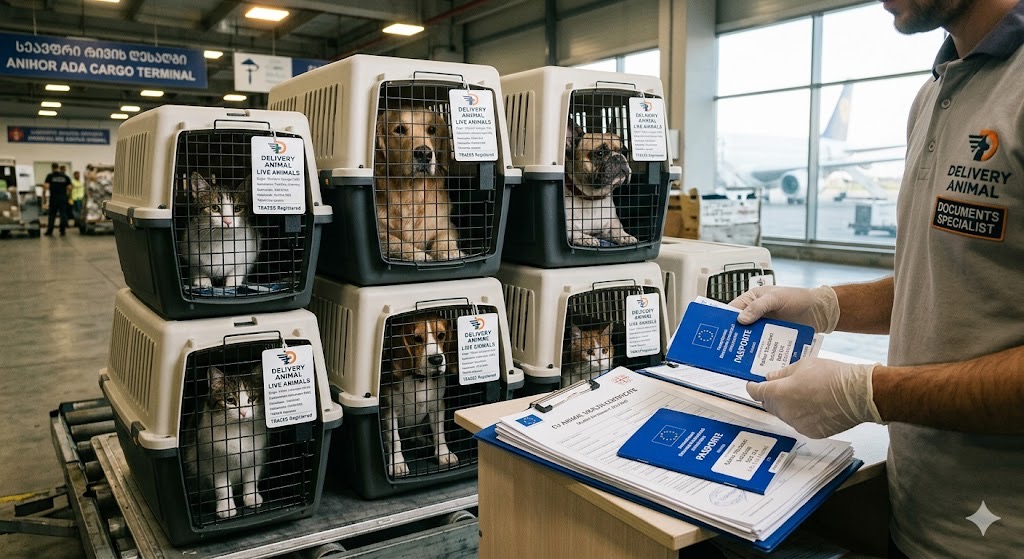
During the commercial import of animals from Georgia, border inspectors check not only the paperwork but also the conditions in which the pets are traveling.
- IATA Boxes: Containers must be rigid, with secure locks and adequate ventilation. The animal must be able to stand upright, turn around, and lie down in a natural position.
- Hygiene: An absorbent mat is mandatory at the bottom of the box.
- Labeling: Each box must have a “Live Animals” sticker and contact details for both the sender and the recipient.
6. Financial Aspects and Duties
A commercial batch implies the payment of import VAT and customs duties in the country of arrival. The amount is calculated based on the invoice value of the animals. We recommend preparing all invoices and sales contracts in advance to expedite clearance at the Border Inspection Post (BIP).
Why Professionals Choose Delivery Animal?
The commercial import of animals from Georgia requires the synchronization of veterinarians, brokers, and logistics experts. At Delivery Animal, we provide:
- Full support within the TRACES system.
- Selection of the optimal route through specialized Border Inspection Posts (BIP) that accept commercial cargo.
- Verification of box compliance with international standards.
- 24/7 monitoring of the animals’ condition throughout the entire journey from Tbilisi or Batumi to any point in Europe.
Conclusion
Planning a commercial shipment should begin at least 4–5 months before the intended departure date. This is due to the strict quarantine timelines following the titer test. Remember that the commercial import of animals from Georgia is a legal responsibility, and the slightest non-compliance with the protocol can lead to significant losses. Contact the experts at Delivery Animal to guarantee the safety of your animals and the integrity of your transaction.