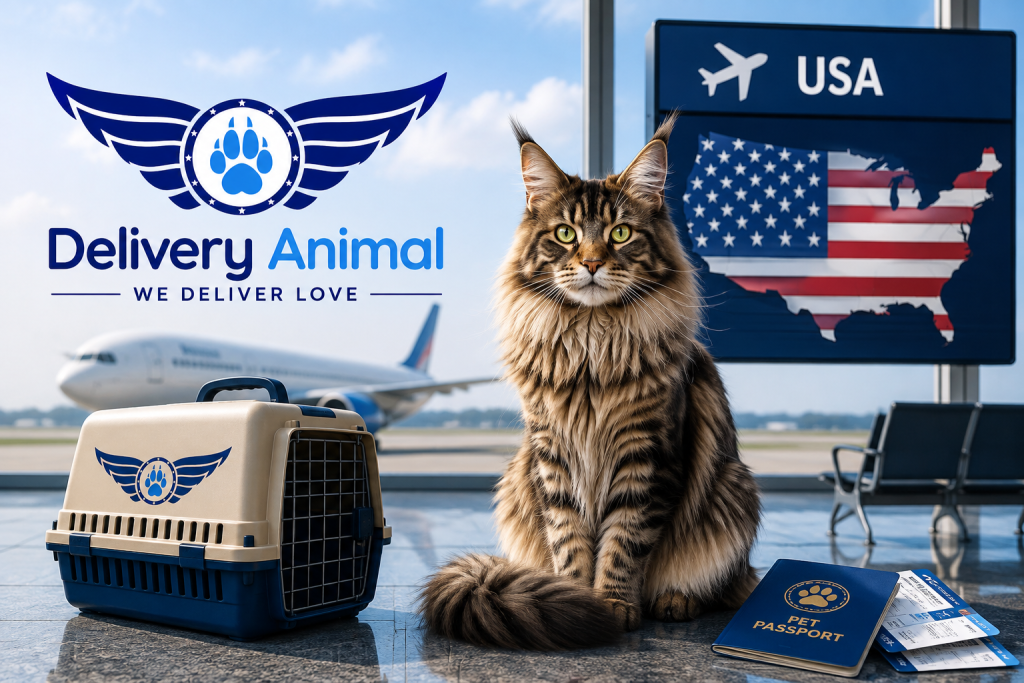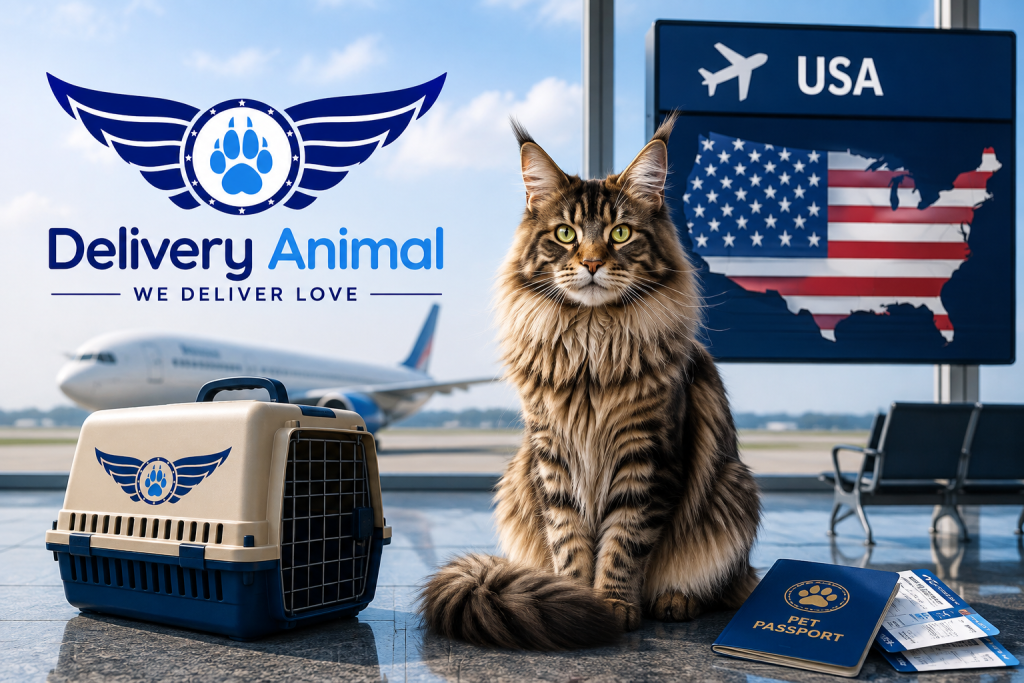

Moving a cat from Georgia to the United States is a good example of a route where the actual federal import requirements are simpler than many owners expect. Pet Transportation of Cats from Georgia to the USA does not require USDA APHIS veterinary import requirements for an ordinary domestic pet cat. However, this does not mean that the preparation can be reduced to buying an airline ticket. CDC requirements, the rules of the destination state, airline conditions and transit-country requirements all need to be checked before the journey.
The most important detail is to determine the final U.S. state and city before choosing the route.
Pet Transportation of Cats from Georgia to the USA: What Does USDA APHIS Require?
For an ordinary domestic pet cat entering the United States from another country, USDA APHIS Veterinary Services does not impose federal animal-health import requirements. APHIS specifically states that there are no APHIS veterinary requirements for bringing a pet cat into the United States from a foreign country.
However, APHIS also points owners toward the requirements of other federal agencies and the destination state or territory.
This means that the absence of USDA requirements should not be interpreted as an absence of all requirements.
The complete route still has to be checked.
Pet Transportation of Cats from Georgia to the USA: CDC Requirements
The Centers for Disease Control and Prevention (CDC) is another important authority.
For cats entering the United States, the CDC requires the animal to appear healthy when it arrives. If a cat appears ill, additional examination may be required before it can be admitted, and the owner may be responsible for the associated veterinary costs.
This creates an important practical rule:
A cat can meet the paperwork requirements and still face additional inspection if it appears sick on arrival.
For a long international journey, a pre-travel veterinary examination is therefore highly advisable.
Pet Transportation of Cats from Georgia to the USA: Is Rabies Vaccination Required?
At the federal level, the CDC does not require proof of rabies vaccination for cats entering the United States.
However, this does not mean that rabies vaccination should simply be ignored.
CDC recommends appropriate rabies vaccination for cats, and the destination state or territory may impose its own requirements.
Therefore, the correct approach is:
check federal requirements → identify the destination state → confirm state requirements → prepare the cat accordingly.
This distinction is especially important when the destination is Hawaii, Guam, Puerto Rico or the U.S. Virgin Islands, where additional local rules may apply.
Pet Transportation of Cats from Georgia to the USA: Does a Health Certificate Need to Be Issued?
A general federal health certificate is not required by USDA APHIS for an ordinary pet cat entering the United States.
Nevertheless, a health certificate may be required by:
- the destination state;
- the airline;
- a transit country;
- a cargo operator;
- another authority involved in the journey.
This is why professional pet relocation planning should not stop after checking the USDA website.
For a long international flight from Georgia, a veterinary health document confirming the cat’s condition can also make the transportation process more straightforward, even where it is not a federal entry requirement.
Pet Transportation of Cats from Georgia to the USA: Why the Destination State Matters
The United States does not have one universal set of pet-entry requirements for every state.
USDA APHIS explicitly notes that state and territorial authorities establish their own requirements for interstate pet movement, and owners should contact the relevant state animal-health authority for the applicable rules.
Therefore:
Georgia → New York
and
Georgia → California
should not automatically be treated as identical routes.
Before booking the flight, determine the final address and verify the rules of that specific state.
Pet Transportation of Cats from Georgia to the USA: Hawaii and U.S. Territories
Extra caution is necessary when the destination is not one of the continental U.S. states.
Hawaii and certain U.S. territories have their own animal-entry systems and quarantine-related procedures.
CDC specifically warns that cats entering Hawaii, Guam, Puerto Rico and the U.S. Virgin Islands can be subject to local requirements in addition to federal rules.
A cat travelling to California, for example, cannot simply be prepared using the same checklist as a cat travelling to Honolulu.
The final destination should therefore be confirmed before veterinary preparation begins.
Pet Transportation of Cats from Georgia to the USA: Microchip Identification
A universal federal microchip requirement does not apply to an ordinary domestic cat under USDA APHIS’s current import rules.
Even so, microchip identification is strongly useful for international relocation.
It creates a clear connection between:
cat → owner → veterinary records → travel documents.
Before departure, check:
- microchip number;
- readability of the chip;
- owner’s contact information;
- veterinary records;
- consistency of the animal’s description in documents.
For a professional transportation company, reliable identification also helps prevent mistakes during airport handling.
Pet Transportation of Cats from Georgia to the USA: Veterinary Examination
Although federal U.S. cat-import requirements are relatively limited, a pre-travel veterinary examination is highly advisable.
The veterinarian can confirm that the animal:
- is clinically fit for travel;
- has no obvious signs of infectious disease;
- is suitable for a long flight;
- has an appropriate vaccination history;
- can tolerate the planned journey.
CDC may require additional examination if the cat appears ill upon arrival.
For elderly cats, kittens, pregnant animals and cats with chronic health issues, a pre-flight assessment becomes particularly important.
Pet Transportation of Cats from Georgia to the USA: Transit Through Another Country
A flight from Georgia to the United States may include a connection in Türkiye, Europe or another international hub.
For example:
Georgia → Türkiye → USA
or
Georgia → Europe → USA
The transit country must be checked separately.
The important question is whether the cat:
- remains inside the international transit zone;
- passes through customs;
- leaves the airport;
- changes airlines;
- requires a new booking;
- is temporarily transferred into the custody of another carrier.
If the animal formally enters the transit country, additional veterinary or import rules may apply.
Therefore, a cheap itinerary with a long transit is not necessarily the best option for a cat.
Pet Transportation of Cats from Georgia to the USA: Cabin or Cargo?
For many cats, cabin travel is the most comfortable option where the airline allows it.
However, airlines establish their own rules regarding:
- maximum carrier dimensions;
- combined pet and carrier weight;
- number of animals in the cabin;
- availability of pet reservations;
- placement of the carrier;
- connecting flights;
- breed restrictions.
A cat that cannot travel in the cabin may need specialized cargo transportation.
This is why the airline should be contacted before the passenger ticket is finalized.
USDA APHIS also emphasizes that pet-travel planning needs to take account of the complete itinerary and the countries through which the pet travels.
Pet Transportation of Cats from Georgia to the USA: Choosing the Right Carrier
The transport carrier is one of the most underestimated parts of international cat travel.
For cabin travel, the carrier must meet the airline’s size and construction requirements.
For cargo travel, the requirements can be substantially different.
The cat should be able to:
- stand naturally;
- turn around;
- lie down comfortably;
- have adequate ventilation;
- remain safely inside during handling.
The carrier should be selected after the airline and transportation method are confirmed.
Pet Transportation of Cats from Georgia to the USA: Special Care for Brachycephalic Cats
Flat-faced breeds require additional caution.
Examples include:
- Persian;
- Exotic Shorthair;
- Himalayan;
- other brachycephalic cats.
Some airlines impose restrictions on brachycephalic animals because of their increased sensitivity to heat, stress and respiratory difficulties.
Therefore, the airline must confirm acceptance of the specific cat before the route is finalized.
A regulatory right to enter the United States does not override an airline’s own safety restrictions.
Pet Transportation of Cats from Georgia to the USA: Kittens
Young kittens require special planning even though U.S. federal rules for ordinary pet cats do not establish the same universal rabies-age framework used for dogs.
The practical limits may instead come from:
- the destination state;
- the airline;
- vaccination schedules;
- the kitten’s physical development;
- the ability to tolerate a long international flight.
For this reason, the earliest possible travel date should be determined based on the complete route rather than simply the kitten’s age.
Pet Transportation of Cats from Georgia to the USA: When Several Cats Travel Together
If several cats are being transported, first determine the legal status of the movement.
A private family relocating with several cats may have a different situation from:
- a breeder;
- a rescue organization;
- a seller;
- a professional animal transporter;
- a shipment involving a change of ownership.
An animal intended for resale or another commercial purpose should not automatically be treated as an ordinary private pet.
The transportation company and relevant authorities should establish the correct category before booking.
Pet Transportation of Cats from Georgia to the USA: What Happens at the U.S. Border?
The cat will be inspected at the point of entry.
CDC states that the animal must appear healthy, and additional veterinary examination may be required if there are signs of illness.
After federal entry procedures, the owner must also comply with the rules of the destination state.
Therefore, the international journey has several stages:
departure from Georgia → transit → U.S. entry → state requirements → final delivery.
The airport arrival is only one part of the process.
Pet Transportation of Cats from Georgia to the USA: The Best Preparation Sequence
A practical preparation plan looks like this:
Step 1 — Determine the final U.S. state and city.
Step 2 — Check CDC and USDA APHIS requirements.
Step 3 — Check state-specific entry requirements.
Step 4 — Review the cat’s medical and vaccination history.
Step 5 — Check the microchip and identification information.
Step 6 — Choose the safest route and transit country.
Step 7 — Confirm cabin or cargo acceptance with the airline.
Step 8 — Select the appropriate carrier.
Step 9 — Complete the veterinary examination and any required documents.
Step 10 — Arrange airport collection and final delivery in the United States.
This approach prevents one of the most common international pet-transport problems: purchasing a passenger ticket before confirming transportation for the animal.
Pet Transportation of Cats from Georgia to the USA With Delivery Animal
Delivery Animal organizes international transportation of cats from Georgia to the United States according to the destination state’s requirements, airline rules and transit route.
Depending on the journey, assistance can include:
- destination-state requirement checks;
- veterinary preparation;
- microchip verification;
- health examination;
- health certificate coordination where required;
- airline booking;
- cabin transportation;
- cargo arrangements;
- transit coordination;
- carrier selection;
- airport collection;
- final delivery in the USA.
Each journey is calculated individually. A Persian cat travelling to New York in the cabin and a large Maine Coon travelling cargo to California can require very different transportation solutions.
Expert Conclusion
Pet Transportation of Cats from Georgia to the USA is relatively straightforward at the federal level because USDA APHIS does not impose animal-health import requirements on ordinary domestic pet cats, while CDC focuses on the cat appearing healthy at entry; however, destination-state rules, airline requirements and transit-country conditions must be checked separately before the journey is booked.
The safest approach is therefore to determine the exact U.S. state first, verify the current requirements through USDA APHIS and CDC, and only then finalize the airline and route.
Delivery Animal coordinates the complete international cat relocation process from Georgia to the USA — from veterinary preparation and flight planning to airport collection and delivery to the final address.