
Planning to travel to the United States with your pet and wondering whether your dog can fly in the aircraft cabin? It is essential to understand the legal difference between a service dog in the USA and an emotional support animal (ESA). These categories are regulated by different federal laws, and airline transportation rules vary significantly.
This article explains the legal distinctions, required documentation, and what is officially permitted under U.S. law.
What Is a Service Dog Under U.S. Law?
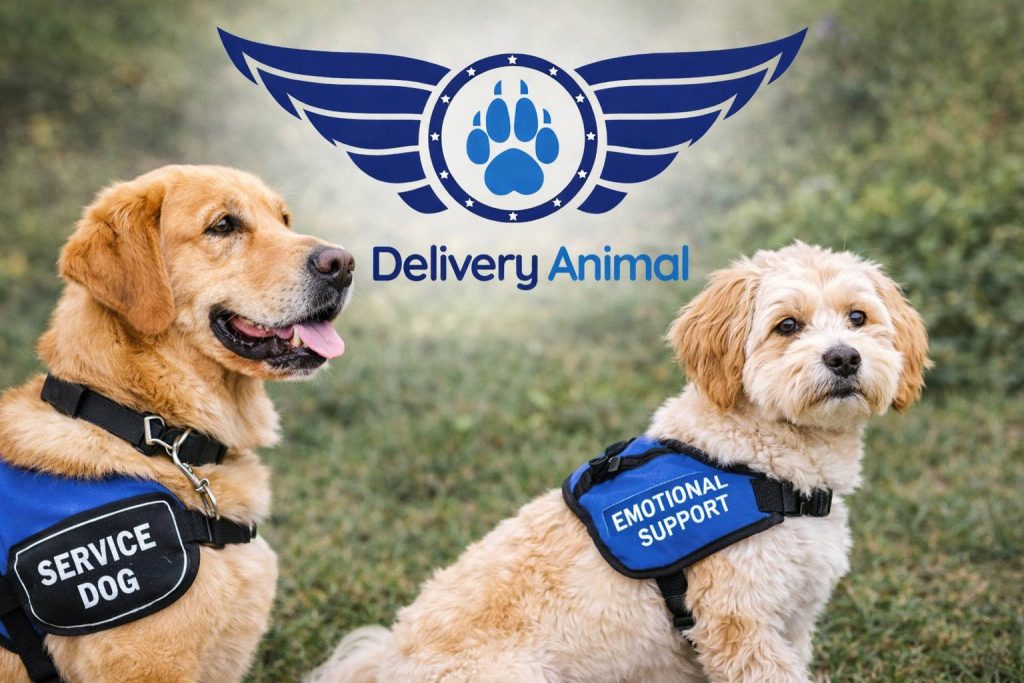
According to the Americans with Disabilities Act (ADA), a service dog is a dog that is individually trained to perform specific tasks for a person with a disability.
The official definition is published by the U.S. Department of Justice on ADA.gov.
Examples of qualifying tasks:
- Guiding individuals who are blind
- Alerting to seizures
- Assisting individuals with diabetes
- Supporting mobility impairments
- Performing psychiatric tasks (e.g., PTSD service dog)
Key Legal Requirement
A service dog must be trained to perform specific tasks directly related to a disability. Emotional comfort alone does not qualify a dog as a service animal under ADA.
📌 Source:
Americans with Disabilities Act (ADA)
https://www.ada.gov/resources/service-animals-2010-requirements/
What Is an Emotional Support Animal (ESA)?
An Emotional Support Animal provides comfort and emotional support but is not required to undergo specialized task-based training.
However, regulations changed significantly in 2021.
According to the U.S. Department of Transportation (DOT) Final Rule:
Airlines are no longer required to recognize Emotional Support Animals as service animals.
This means:
- Airlines are not obligated to transport ESAs free of charge.
- ESAs are treated as regular pets.
- Standard pet size and carrier restrictions apply.
📌 Source:
U.S. Department of Transportation (DOT)
https://www.transportation.gov/individuals/aviation-consumer-protection/service-animals
Can a Dog Fly in the Cabin Without Weight Limits?
Under DOT regulations:
✔ A service dog may fly in the cabin without additional fees.
✔ There is no formal weight limit.
✔ The dog must fit safely within the passenger’s foot space.
Airlines may deny boarding if:
- The dog is too large to safely accommodate.
- The dog poses a safety risk.
- The dog behaves aggressively or disruptively.
Therefore, the claim that “any dog of any size can always fly in the cabin” is not supported by official regulations.
Required Documents for a Service Dog
For air travel within the United States, airlines require:
1. DOT Service Animal Air Transportation Form
Confirms health, vaccination, training, and behavioral control.
2. DOT Relief Attestation Form
Required for flights longer than 8 hours.
Official forms are available on the DOT website:
https://www.transportation.gov/individuals/aviation-consumer-protection/service-animals
Important Legal Clarification
There is no federal registration system or official government-issued service dog certificate in the United States. Any private “ID cards” sold online are not legally required under ADA.
This is explicitly stated on ADA.gov.
How to Qualify for Service Dog Status
Step 1: Qualifying Disability
The individual must have a disability as defined under ADA.
Step 2: Individual Task Training
The dog must be trained to perform specific tasks related to that disability. Federal law does not require government certification, but the training must be legitimate and functional.
Step 3: Submission of DOT Forms
Passengers must submit required forms to the airline before travel.
Why Legal Compliance Matters
Understanding:
- ADA federal law
- DOT aviation regulations
- Airline-specific policies
- Veterinary requirements
is essential.
Errors in documentation or misunderstanding of regulations may result in denied boarding.
Delivery Animal provides professional consultation and document preparation support in compliance with current U.S. federal regulations.
Additional Legal Considerations
A service dog in the USA is protected under ADA, but different rules may apply depending on the setting — housing, public access, or transportation.
Air travel is regulated specifically by DOT rules. Airlines retain the authority to determine compliance and safety standards.
Failure to meet documentation and behavior requirements may result in denied access, even if the dog qualifies under ADA.
Conclusions Based on Official Sources
- Service dogs and ESAs are legally distinct categories.
- ESAs are not guaranteed free cabin transport.
- Service dogs may fly in the cabin if DOT requirements are met.
- There is no federal service dog registry.
- Airlines make final decisions based on DOT rules.
Before preparing documentation, always rely on official ADA and DOT regulations.
Official Sources
Americans with Disabilities Act (ADA)
https://www.ada.gov/resources/service-animals-2010-requirements/
U.S. Department of Transportation (DOT)
https://www.transportation.gov/individuals/aviation-consumer-protection/service-animals
If you need professional assistance in preparing your Service Dog for a flight to the USA, you can find out more about our international animal transportation services on our official website.