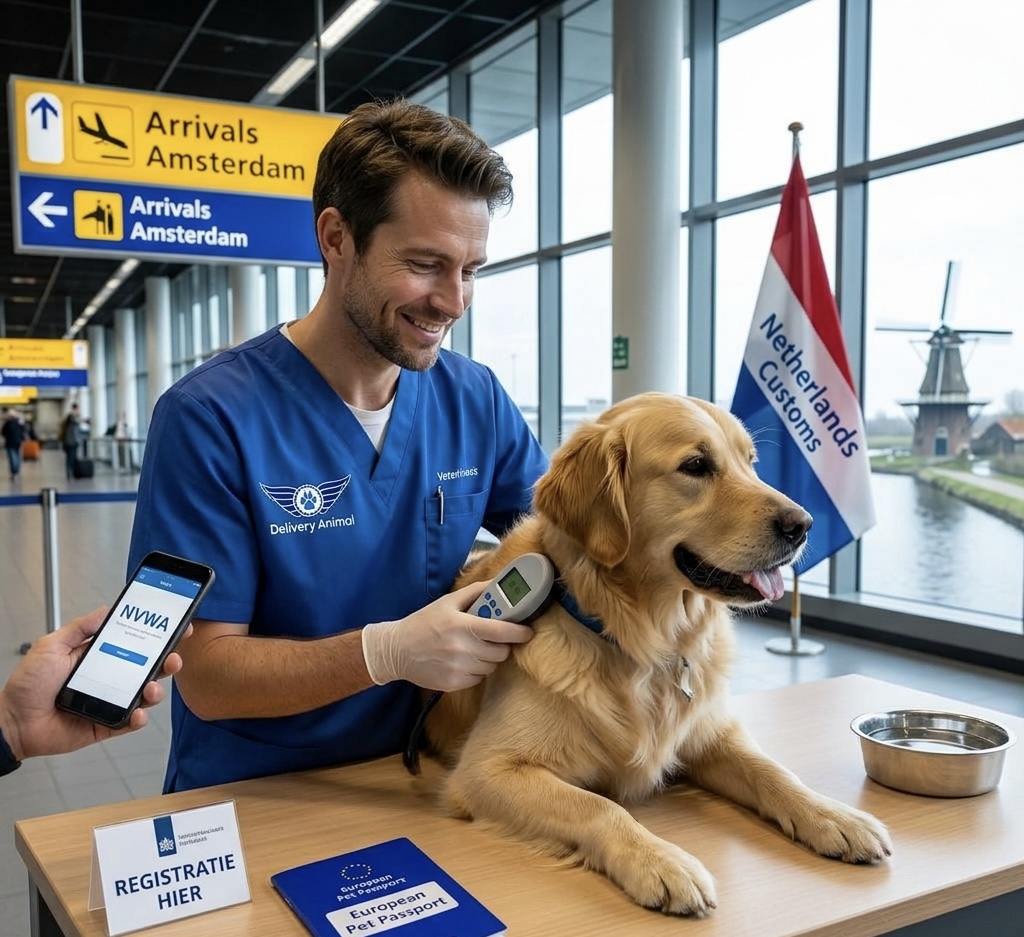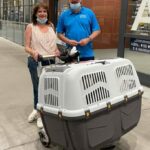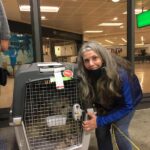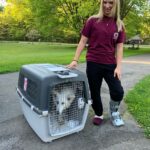

When planning the import of dogs to the Netherlands, pet owners in 2026 face a multi-layered system of veterinary and state control. As part of the European Union, the Netherlands strictly adheres to Regulation (EU) No. 576/2013. However, internal digital tracking systems (I&R) make the process of pet legalization unique. In this article, we break down every stage—from the first injection to obtaining a Dutch registration number—to ensure your relocation proceeds without the risk of quarantine.
1. Fundamental Requirements: Microchipping and Primary Preparation
The first and most critical rule: the import of dogs to the Netherlands is impossible without prior identification. In 2026, customs services (Douane) and NVWA veterinary inspectors require strict adherence to the chronology of procedures.
1.1. The Microchip as an Identity Passport
A dog must be microchipped before or on the same day as the rabies vaccination. The microchip must comply with ISO technical standard 11784 or Annex A to ISO standard 11785. If the chip does not meet these standards, the owner is required to provide their own scanning device. Remember, the microchipping entry in the veterinary passport must precede the vaccination date; otherwise, the entire document package will be voided at the border.
1.2. Rabies Vaccination
For the import of dogs to the Netherlands, only vaccines approved in the EU or the country of origin (provided they are WHO certified) are accepted.
- Age Requirement: Puppies under 12 weeks old are not permitted for entry, as vaccination at an earlier age is not considered effective.
- Waiting Period: Following the primary vaccination, a mandatory 21-day quarantine period must pass. Only after this time does the animal gain the right to cross the border.
2. Antibody Titer Test: A Critical Step for “Red List” Countries
If you are managing the import of dogs to the Netherlands from countries with a high risk of rabies (countries not listed in Annex II to Regulation 577/2013), a serological test is required.
2.1. Procedure and Timelines
The test must be conducted in an EU-approved laboratory. Blood must be drawn no sooner than 30 days after vaccination. The result must show an antibody level of at least 0.5 IU/ml.
Important: After the blood draw, the dog must remain in the country of departure for at least 3 full months before entry. This period confirms that the animal is healthy and is monitored during the incubation period. Titer tests do not need to be repeated as long as you adhere to the revaccination schedule specified by the manufacturer.
3. Official Documentation and Customs Codes
When crossing the border to confirm the import of dogs to the Netherlands, the owner must present an EU Veterinary Health Certificate.
3.1. Obtaining the Certificate
This document is issued by a government veterinarian in the exporting country within 10 days of arrival at the EU entry point. The certificate must be accompanied by documentary evidence of microchipping and vaccination. For air travel in 2026, it is also recommended to have a copy in English or Dutch to avoid delays at Schiphol Airport.
3.2. Commercial vs. Non-Commercial Import
If one person transports more than 5 dogs, it is classified as a commercial import, which requires entirely different veterinary checks (the TRACES system). For private individuals, signing a declaration stating that the animals are not intended for sale or transfer of ownership is mandatory.
4. Post-Entry Control: RVO Registration and the UBN Number
Many owners mistakenly believe that the legal import of dogs to the Netherlands ends at customs. In 2026, this is only half the journey. The country enforces a mandatory Identification and Registration (I&R) system.
4.1. Obtaining a UBN (Unique Business Number)
Even if you are not a professional breeder, as a dog owner, you are required to have a UBN number. Without this number, no veterinarian in the Netherlands is authorized to perform medical procedures on your pet. Registration takes place on the RVO.nl portal via the DigiD system.
4.2. Chip Legalization and Vet Visit
Within 14 days of completing the import of dogs to the Netherlands, you must take your pet to a local veterinarian. The doctor will verify international documents, scan the chip, and enter the data into one of the national databases (such as PetBase or NDG). Only then is your dog officially considered a “resident” of the country.
5. Owner Responsibility: Taxes and Walking Rules
Once you have completed the import of dogs to the Netherlands, you become subject to local municipal law.
- Hondenbelasting (Dog Tax): The tax amount depends on the municipality (Gemeente). While some cities have abolished the tax, in centers like The Hague, it remains mandatory and progressive (higher fees for a second dog).
- Walking Rules: In residential areas, dogs must be on a leash. For off-leash exercise, specific Losloopgebiedzones are provided.
Conclusion and 2026 Summary
In summary, a successful import of dogs to the Netherlands requires early planning (at least 4 months in advance if titers are needed). Most owner errors are related to violating the “chip-then-vaccinate” sequence and ignoring RVO registration after arrival. Following all stages ensures your pet’s safety and prevents legal issues in your new country.
Official Information Sources:
- NVWA (Nederlandse Voedsel- en Warenautoriteit)
- RVO (Rijksdienst voor Ondernemend Nederland)
- European Commission (Pet Movement Regulations)
If you are planning a move or a trip with your pet, the specialists at Delivery Animal can help organize safe international pet transportation—find more details on our website.