
Dog import to Spain in 2026 remains a procedure that requires extreme precision in documentation. Spanish legislation, synchronized with European standards, allows no exceptions: in the absence of any mandatory requirements, the animal may be sent to mandatory quarantine or deported. If you are planning a relocation, preparation must begin at least 4 months before your departure date.
In this article, we will detail how to successfully complete a dog import to Spain in 2026 without bureaucratic errors, based on official data from the Spanish Ministry of Agriculture (MAPA) and Regulation (EU) No. 576/2013. Keep in mind that rules may vary slightly depending on whether you are arriving from an EU member state or from so-called “third countries.” However, the basic algorithm described below is a mandatory foundation for every responsible owner.
1. Identification and Primary Vaccination
The first and most critical stage, without which dog import to Spain in 2026 is impossible, is the correct chronology of microchipping and vaccination. The order of actions here has legal significance.
ISO Standard Microchip
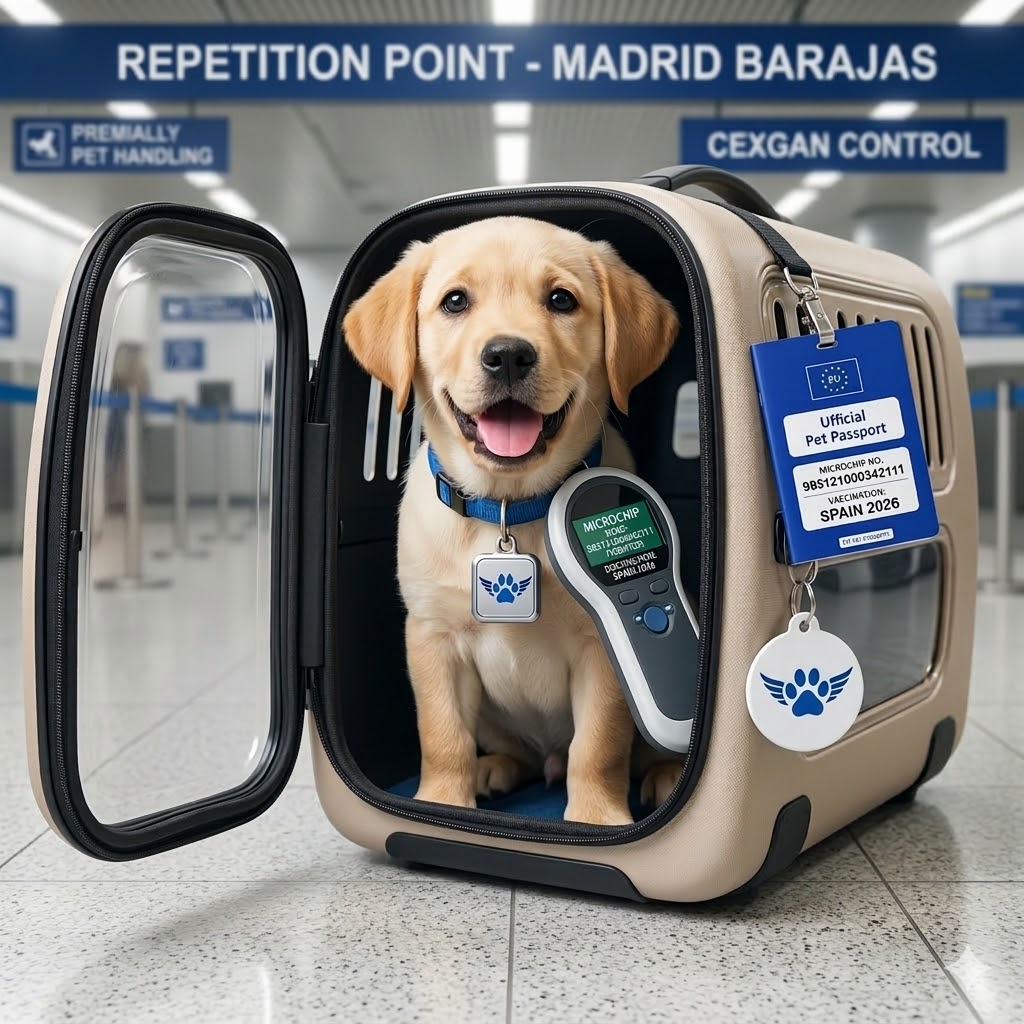
Your dog must have a microchip that complies with international ISO 11784 or ISO 11785 standards. If the chip is in another format, the owner will need to bring their own scanner to read the code at the border.
- Crucial Rule: The chip must be implanted and read by a veterinarian strictly BEFORE the rabies vaccination is administered. Otherwise, the vaccination will not be recognized as valid for EU entry, and you will have to repeat the vaccination procedure after microchipping.
Rabies Vaccination in 2026
Spain only accepts animals whose vaccination was performed after they reached 12 weeks of age.
- Waiting Period: The vaccine is considered “active” for customs only 21 days after the first injection.
- Revaccination: If you follow the schedule of annual boosters and have documentary proof in the pet passport, the 21-day rule for subsequent doses does not apply.
- Age Limit: The import of puppies under 15 weeks (12 weeks for vaccination + 21 days of waiting) to Spain is strictly prohibited.
2. Antibody Titers: Procedure and Waiting Times
For many owners, dog import to Spain in 2026 becomes a challenge specifically at the stage of passing the antibody titer test. This analysis is mandatory for all countries with a high risk of rabies (including Turkey, Georgia, Serbia, and many CIS countries).
Step-by-Step Test Algorithm:
- Blood Sampling: Performed no earlier than 30 days after the last rabies vaccination.
- Accreditation: The blood must be tested exclusively in an EU-certified laboratory.
- Result: The antibody level must be at least 0.5 IU/ml.
- Quarantine Period: After receiving a successful result, the dog can only enter Spain after 3 full months. This waiting period is mandatory, and it is impossible to shorten it through legal means.
Important Nuance: If you are planning a dog import to Spain in 2026 in transit through other EU countries, the presence of titers will be checked at the first point of crossing the European Union border.
3. Obtaining the EU Veterinary Certificate
The primary travel document is the Veterinary Certificate (Health Certificate), also known as “Annex IV.”
Documentation Features in 2026:
- Validity Period: The document must be issued by a state veterinarian no earlier than 10 days before arrival at the Spanish border control point.
- Language Support: The certificate must be completed in both Spanish and English.
- Validation: The document confirms not only vaccinations and the chip but also that the dog has undergone a clinical examination and is healthy enough for transport.
In addition to the certificate, the owner signs a Declaration of Non-Commercial Import. This document confirms that the dog import to Spain in 2026 is not related to a subsequent sale or transfer of ownership.
4. Transport Specifics and Airline Rules
Even if all documents are in order, dog import to Spain in 2026 can fail due to an improperly chosen carrier or crate.
Transport Requirements:
- Airlines: Spain’s national carriers, such as Iberia and Vueling, have limits on the number of animals in the cabin (usually up to 2 per flight). The dog’s weight, including the carrier bag, must not exceed 8 kg.
- Cargo Hold: Large dogs are transported in rigid IATA-standard containers. The container must be spacious enough for the dog to stand up and turn 360 degrees.
- Points of Entry: In 2026, entry with animals is allowed only through authorized airports with veterinary control points (Cexgan), such as Madrid-Barajas (MAD) or Barcelona-El Prat (BCN).
5. Special Status: “Dangerous Breeds” (PPP)
When planning a dog import to Spain in 2026, be sure to check if your pet is on the list of Perros Potencialmente Peligrosos (PPP). These include Rottweilers, Staffordshire Terriers, American Pit Bull Terriers, Akita Inus, and several other breeds.
What is Required in Spain:
- Obtaining a municipal license within one month of arrival.
- Psychological fitness testing for the owner.
- Mandatory third-party liability insurance with coverage starting from €120,000.
Conclusion and Expert Insight
Completing a dog import to Spain in 2026 is a complex but achievable task if you follow the schedule strictly.
Final Takeaways:
- Time Buffer: Start the process 120 days before the trip (titers + quarantine).
- Data Accuracy: Any typo in the chip number on the veterinary certificate invalidates the document.
- Professional Approach: If you are unsure of your abilities, it is better to entrust your dog import to Spain in 2026 to specialized delivery services like Delivery Animal, who will handle the veterinary audit and logistics.