
Why Sleep Is Important for Pets
Sleep is not just rest. For domestic cats and dogs, sleep is a critically important physiological necessity. During sleep, an animal’s body restores its strength: it allows the nervous system to rest, helps muscles and organs recover, supports the immune system, and enables the brain to “process” the events of the day and switch into recovery mode.
In addition, sleep plays a key role in a pet’s psycho-emotional state. Regular and calm sleep helps reduce stress and anxiety and supports emotional stability. This is especially important in noisy households, families with children, or homes where cats and dogs live in apartments and are exposed to many external stimuli.
Sleep also allows the body to “reset” and the brain to process information, which is essential for cognitive functions, memory, and learning.
Thus, for a pet’s health, behavior, emotional and physical well-being, sleep is a fundamental need that must not be ignored.
How Much Do Cats and Dogs Sleep — Norms, Age, and Daily Rhythm
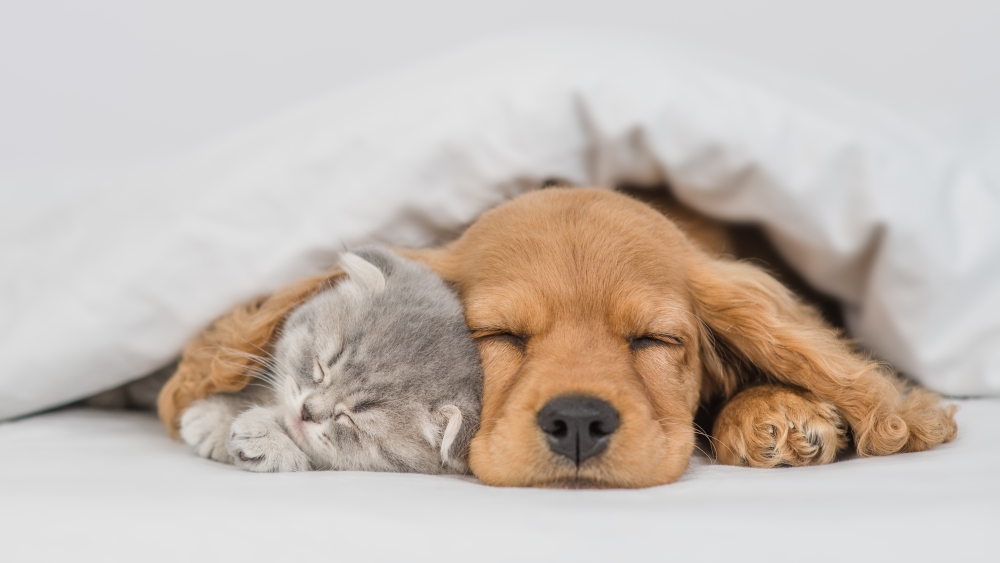
🐱 Cats
Adult domestic cats usually sleep 12–16 hours per day.
Depending on age, living conditions, and activity level, some cats need more sleep. Senior cats or cats with low activity may rest up to 18–20 hours a day.
Sleep duration is especially long in kittens:
- Newborn kittens can sleep up to 23 hours a day
- At 1 month — about 20 hours
- By 2 months — around 19 hours
- With age, sleep duration gradually approaches adult levels
Cats often have polyphasic sleep: instead of one long sleep like humans, they take many short naps throughout the day — this is their natural rhythm.
Cats are essentially crepuscular animals: they are most active at dawn and in the evening, while during the day and late night they usually sleep or rest.
🐶 Dogs
Adult dogs sleep on average 10–14 hours per day.
Puppies, young dogs, senior dogs, and large breeds may sleep longer — sometimes up to 16–18 hours a day, especially during growth or after high energy expenditure.
Dogs also tend to have polyphasic sleep, combining nighttime sleep with daytime naps. Dogs living in human households often adapt their sleep–wake rhythm to the family’s daily routine.
As with cats, many factors influence dog sleep: age, activity level, breed, living conditions, daily schedule, and health.
How Sleep Affects Health, Mood, and Behavior
✅ Benefits of Adequate Sleep
Physical recovery and health maintenance
Sleep allows pets to restore resources and recover, especially after physical activity, play, or walks. For puppies and kittens, long sleep is a crucial part of growth and development.
Emotional balance
Regular, calm sleep helps animals stay emotionally stable, reduces stress, anxiety, and irritability, and allows them to react more calmly to changes, noise, and new stimuli.
Cognitive functions, learning, and memory
During sleep, the animal’s brain processes experiences and information, improving memory, learning ability, and adaptability.
Adaptation to routine and biological rhythms
A stable sleep–wake schedule helps pets adapt to their owners’ routines, feel safe, confident, and emotionally balanced.
⚠️ What Can Go Wrong: Consequences of Poor Sleep
Behavioral problems
Lack of sleep or poor sleep quality may lead to irritability, anxiety, aggression, hyperactivity, and unstable mood. Dogs may respond worse to commands; cats may become nervous or restless.
Weakened immunity and health decline
Without proper rest, the body cannot recover fully, which may reduce resistance to illness and slow recovery from stress or disease.
Learning and adaptation difficulties
Sleep-deprived pets have trouble concentrating, remembering commands, and adjusting to new environments.
Stress and disrupted life rhythm
Chaotic sleep patterns, frequent awakenings, or constant environmental changes may cause stress, anxiety, and insecurity — especially in sensitive animals.
Important: noticeable changes in sleep patterns — sleeping much more or much less than usual, restlessness, apathy, or behavioral changes — may indicate stress, illness, discomfort, or age-related issues and should not be ignored.
What Influences Sleep — External Factors, Age, and Lifestyle
Sleep duration and quality in cats and dogs depend on many factors:
- Age — kittens and puppies sleep much more; senior animals also tend to rest longer
- Activity level — physically and mentally active animals need quality sleep to recover
- Environment and living conditions — noise, light, temperature, and a sense of safety strongly affect sleep quality
- Breed, physiology, and health — breed traits, health conditions, and age influence sleep needs
- Household routine — stable daily schedules help pets maintain healthy sleep rhythms; chaotic routines disrupt them
Practical Tips for Owners — How to Help Pets Sleep Well
To support healthy sleep and overall well-being:
- Provide a quiet, comfortable, and safe sleeping place
- Maintain a stable daily routine (feeding, walks, play, rest)
- Ensure sufficient physical and mental activity during the day
- Monitor changes in sleep and behavior
- Consider age, health, and breed characteristics
- Create a cozy, calm sleep environment with minimal noise and appropriate temperature
Why Sleep Is About Balance, Not Just “Sleeping a Lot”
Sleep is an active recovery process — physical, mental, and neurological.
Too little activity during the day may lead to apathy, boredom, and weight gain, even if the pet sleeps many hours.
Too little or poor-quality sleep overloads the nervous system and weakens immunity.
The optimal balance includes:
- active daily life (play, walks, stimulation)
- a stable daily routine
- a calm and comfortable sleeping area
- age-appropriate physiological needs
📝 Conclusion
Sleep is not a minor household detail but a fundamental need that determines a pet’s health, behavior, mood, and quality of life. The number of sleeping hours is important, but sleep quality, routine stability, and balance between rest and activity are even more crucial.
Cats and dogs differ in rhythms and physiology, but both need comfort, safety, and attentive care.
When these principles are respected, pets sleep deeply, recover fully, feel calm and secure — and live healthy, happy lives.
📚 Official Sources
Purina — How Much Do Cats Sleep
https://www.purina.ru/articles/cats/behaviour/skolko-spyat-koshki
Purina — How Much Do Dogs Sleep
https://shop.purina.ru/article/skolko-spyat-sobaki
The Environmental Literacy Council — Who Sleeps More: Dog or Cat?
https://enviroliteracy.org/who-sleeps-more-dog-or-cat/
BB.LV — How Many Hours a Day Should a Dog or Cat Sleep
https://bb.lv/statja/v-mire-zhivotnyh/2024/11/27/skolko-casov-v-den-dolzna-spat-sobaka-ili-koska
International Journal of Molecular Zoology — Sleeping Habits and Behaviors of Cats, 2023
https://animalscipublisher.com/index.php/ijmz/article/download/3756/2844
Animal Behavior Associates — Sleep and Dreams in Dogs and Cats
https://www.animalbehaviorassociates.com/pdf/RMN_sleep_dreams.pdf