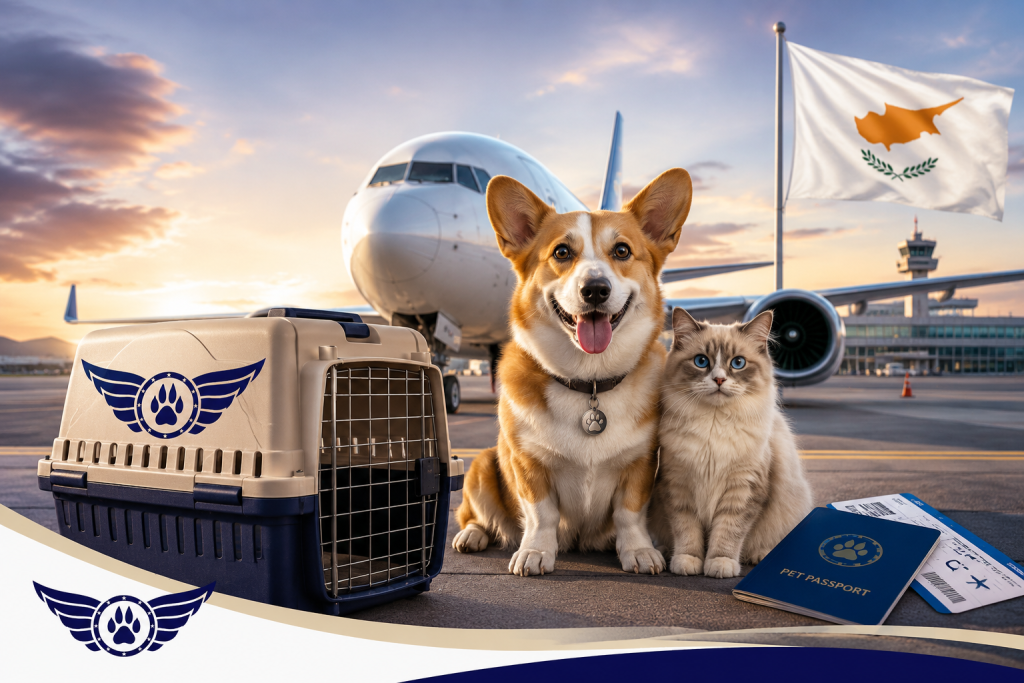

Pet transportation to Cyprus requires careful planning because the country applies specific veterinary and movement-control requirements to dogs, cats and other companion animals. For pets arriving from EU Member States, the procedure is generally based on the EU pet-travel framework, while animals arriving from third countries may need additional documentation and, depending on the origin country, a rabies antibody titration test.
For owners moving to Cyprus with a dog or cat, the most important point is to calculate the preparation schedule before booking the final flight.
Pet Transportation to Cyprus Starts With Identification
A dog or cat must be individually identified before travelling.
Cyprus accepts an electronic transponder (microchip) meeting the relevant ISO standards. A tattoo can also be accepted in specific cases when it was applied before 3 July 2011. Importantly, the rabies vaccination must not have been administered before the animal’s identification.
The practical sequence should therefore be:
microchip → rabies vaccination → veterinary documentation → travel.
This detail is particularly important when preparing a puppy or kitten for its first international journey.
Rabies Vaccination for Cyprus
Valid rabies vaccination is mandatory for dogs, cats and ferrets entering Cyprus.
For a primary vaccination, the animal must be at least 12 weeks old. After completion of the primary vaccination protocol, at least 21 days must pass before the animal can travel. Cyprus Veterinary Services specifically clarify that the vaccination day is counted as day zero.
A booster vaccination can remain valid from the date of administration when it is given within the validity period established for the previous vaccination.
If previous vaccination cannot be properly documented, the vaccination may be treated as a primary vaccination. This is why keeping the original veterinary records is important.
Minimum Age for Pet Transportation to Cyprus
The vaccination requirements effectively establish a minimum entry age.
Cyprus does not permit the entry of pet animals younger than 105 days, regardless of their country of origin.
This is particularly relevant when transporting young puppies and kittens.
An animal may already be old enough to receive its first rabies vaccination but still be too young to legally enter Cyprus.
Rabies Antibody Titration Test
One of the most important questions in pet transportation to Cyprus is whether a rabies antibody test is required.
For animals coming from countries or territories that are not included in the relevant EU list, Cyprus requires a rabies neutralising antibody titration test.
The procedure has several stages:
- The animal receives the required rabies vaccination.
- A blood sample is taken at least 30 days after vaccination.
- The test is performed by an EU-approved laboratory.
- The antibody level must be at least 0.5 IU/ml.
- The animal must generally wait three months from the blood-sampling date before travelling.
As a result, starting the preparation from zero can take approximately four months.
This is why owners from certain third countries should not wait until a few weeks before relocation to begin preparing their pets.
Does the Rabies Titer Have to Be Repeated?
Not necessarily.
If the animal is revaccinated within the validity period recommended by the vaccine manufacturer, the existing successful rabies antibody titration generally does not need to be repeated.
This makes maintaining an uninterrupted vaccination history extremely important.
For animals returning to the EU whose documentation already proves a successful titration performed before leaving the EU, different rules can apply to the three-month waiting period.
Health Certificate for Pets From Third Countries
Dogs and cats arriving from third countries generally need an EU model Animal Health Certificate or an applicable third-country passport recognized under the rules.
The Health Certificate must certify the animal’s compliance with the relevant veterinary requirements and include the owner’s declaration that the movement is non-commercial.
The certificate is valid for 10 days from the date of issue by the official veterinarian. For sea transportation, the validity period is extended by the duration of the sea journey.
This means that the final certification stage must be carefully synchronized with the departure date.
Notification Before Arrival in Cyprus
Another requirement that can easily be overlooked is advance notification.
When a pet arrives from a third country, the owner or responsible person must notify the relevant District Veterinary Office about the arrival.
The notification must be made at least 48 hours before arrival and should include information such as:
- arrival date;
- arrival time;
- flight number or ship name;
- information about the pet.
For cargo transportation, this step is especially important because the animal may arrive without its owner.
Approved Entry Points
Pet animals cannot simply enter Cyprus through any airport or port.
Cyprus Veterinary Services state that pets may enter through designated airports, ports and marinas. Entry through another point is prohibited.
Therefore, the entry point should be confirmed before the airline route is finalized.
This is particularly important when an itinerary includes several flight segments or a combination of air and sea transportation.
Breed Restrictions in Cyprus
Cyprus has national restrictions concerning certain dog breeds.
The entry of the following breeds is prohibited:
- Pit Bull Terrier / American Pit Bull;
- Japanese Tosa / Tosa Inu;
- Dogo Argentino / Argentinian Mastiff;
- Fila Brasileiro / Brazilian Mastiff.
The restrictions can also apply to crosses involving these breeds when the characteristics of the prohibited breed are considered dominant by a registered veterinarian.
Therefore, owners of mixed-breed dogs should verify the animal’s documentation before arranging transportation.
Restrictions on Hybrid Cats
There is also a specific restriction concerning cats.
Cyprus prohibits the entry of cats that do not belong to the species Felis silvestris catus. The official rules specifically mention hybrid types such as Savannah, Bengal and Caracat, including their hybrids.
Owners of hybrid cats should therefore obtain confirmation of admissibility before purchasing a ticket.
How Many Pets Can Travel to Cyprus?
Under the non-commercial movement rules, a maximum of five pet animals may accompany an owner or authorized person during a single journey.
There is an exception when animals are travelling to participate in:
- competitions;
- exhibitions;
- sporting events;
- training for such events.
In these cases, the animals must be over six months old and the owner must provide appropriate evidence of registration for the event.
If more than five animals are transported without meeting the conditions for the exception, commercial-movement requirements may apply.
Pet Transportation to Cyprus by Air
For air travel, the pet’s container must meet the applicable IATA specifications.
However, an IATA-compliant carrier does not automatically mean that every airline will accept the animal.
The airline should be contacted in advance to confirm:
- whether pets are accepted;
- cabin or cargo transportation;
- maximum weight;
- carrier dimensions;
- breed restrictions;
- connection requirements;
- temperature restrictions;
- availability on every flight segment.
A route that is convenient for the passenger may not necessarily be the safest or most practical option for the animal.
What Happens When the Pet Arrives?
Upon arrival, the animal and its documents are inspected by a Veterinary Officer or Customs Officer.
If the applicable requirements have been fulfilled, the pet can enter Cyprus.
If the requirements have not been fulfilled, Cyprus Veterinary Services may require the animal to be:
- returned to the country of origin;
- placed in quarantine for the necessary period;
- in circumstances where re-export or quarantine is not feasible, euthanised.
The owner is responsible for the applicable inspection and quarantine costs.
This makes document verification before departure far more important than trying to resolve a veterinary problem after arrival.
Pet Transportation to Cyprus From Ukraine, Turkey, the USA and Other Countries
The preparation process depends heavily on the country from which the pet is travelling.
For example, the routes:
Ukraine → Cyprus
Turkey → Cyprus
USA → Cyprus
Kazakhstan → Cyprus
should not automatically be treated as identical.
The first question is whether the origin country is included in the relevant EU list for pet movement.
The second is whether a rabies antibody titration test is required.
The third is whether the chosen transit route changes the veterinary requirements.
Cyprus provides a specific transit exception in certain circumstances where an animal passes through a non-listed territory but remains protected from contact with animals susceptible to rabies and stays secured within transport or the perimeter of an international airport.
Therefore, the entire route must be checked, not just the final destination.
A Practical Timeline for Pet Transportation to Cyprus
For an animal that requires a rabies antibody test, preparation can be organized as follows:
Step 1: Confirm the destination and origin-country requirements.
Step 2: Check the microchip.
Step 3: Complete the valid rabies vaccination.
Step 4: Wait at least 30 days before blood sampling when a titration test is required.
Step 5: Complete the antibody test in an EU-approved laboratory.
Step 6: Observe the required three-month waiting period where applicable.
Step 7: Select an approved Cypriot entry point.
Step 8: Confirm the airline and transportation method.
Step 9: Arrange the official Health Certificate.
Step 10: Notify the relevant District Veterinary Office at least 48 hours before arrival.
This sequence helps prevent one of the most common international pet-transport problems: having a flight booked before the animal is legally ready to travel.
Pet Transportation to Cyprus With Delivery Animal
Delivery Animal helps owners organize international transportation of dogs and cats to Cyprus based on the animal’s origin, destination, veterinary status and travel route.
Our assistance can include:
- route planning;
- veterinary document review;
- rabies vaccination planning;
- rabies antibody titration coordination;
- Health Certificate preparation;
- airline arrangements;
- IATA-compliant transport crate preparation;
- cargo transportation;
- transit coordination;
- airport procedures;
- arrival coordination;
- door-to-door pet transportation.
Every case is assessed individually because the requirements for a dog travelling from Ukraine may differ substantially from those for a cat travelling from Turkey or the United States.
Expert Conclusion
Pet transportation to Cyprus should be planned several months in advance when a rabies antibody titration test is required, because the preparation can involve vaccination, blood sampling, laboratory testing and a mandatory waiting period; owners should verify the current requirements with the official Veterinary Services of the Republic of Cyprus before finalizing the route and departure date.