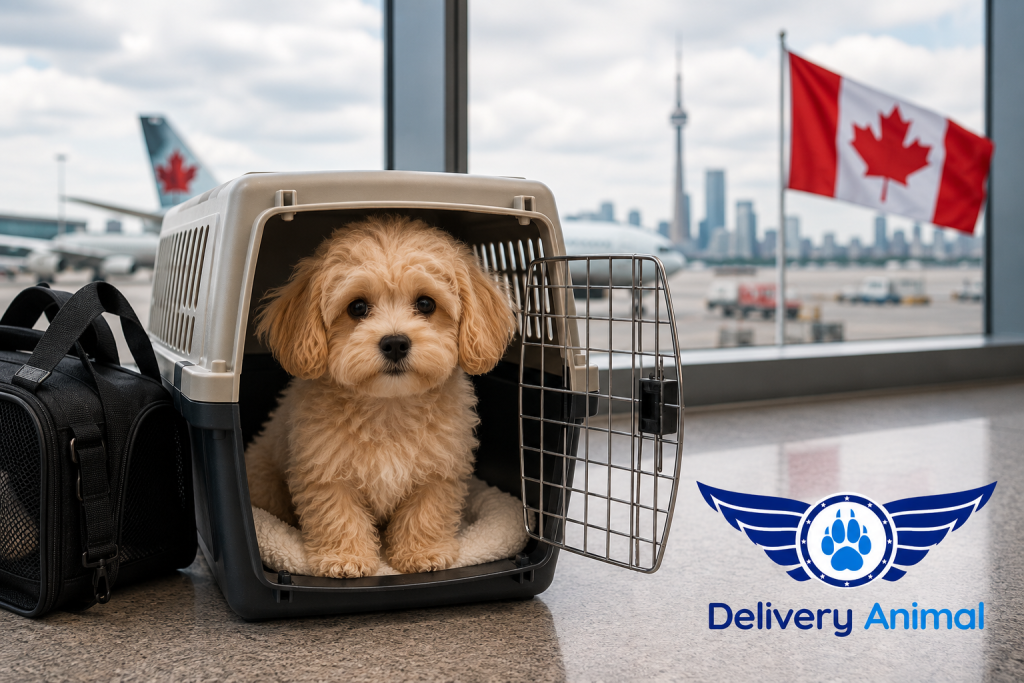

Dog transport from Kazakhstan to Cyprus requires advance veterinary preparation, correct documentation, and coordination of the international route. Since the Republic of Cyprus is a member state of the European Union, dogs imported from Kazakhstan must comply with EU requirements for the movement of pets from third countries, as well as the procedures established by the Veterinary Services of the Republic of Cyprus.
Owners must check the animal’s microchip, rabies vaccination history, whether a Rabies Antibody Titration Test (RNATT) is required, prepare the appropriate veterinary certificate, and determine the pet’s point of arrival.
Delivery Animal organises international pet transportation, helps owners check veterinary documents, calculate preparation timelines, and select a suitable route. Professional dog transport from Kazakhstan to Cyprus begins with an analysis of the individual pet’s documents and determination of the earliest permitted date of entry.
Rules for Dog Transport from Kazakhstan to Cyprus
Dog transport from Kazakhstan to Cyprus begins with determining the veterinary requirements applicable to the specific animal. The microchip implantation date, rabies vaccination history, purpose of the dog’s movement, and intended travel date must all be taken into account.
Cyprus applies the common EU rules governing the import of dogs, cats, and ferrets from third countries. In addition, the national procedures of the Veterinary Services of the Republic of Cyprus regarding notification of arrival and veterinary checks must be considered.
The import of pets that have not been vaccinated against rabies into the Republic of Cyprus is not permitted. The animal must comply with identification, vaccination, and veterinary certification requirements.
At the same time, dog transport from Kazakhstan to Cyprus must be planned according to the classification of the country of origin under European Union rules. Before purchasing airline tickets, owners must check whether the specific animal requires a rabies antibody titre test and determine the legally permitted date of entry.
Official requirements for the non-commercial movement of pets are published by the Veterinary Services of the Republic of Cyprus and the European Commission.
Microchipping a Dog Before Transportation
The first stage of veterinary preparation is the identification of the animal.
The dog must have a microchip whose number allows the pet to be clearly matched with its veterinary documents.
The microchip must be implanted before the rabies vaccination used for international transportation. If the vaccination was administered before the animal was identified, the subsequent preparation procedure should be reviewed with a veterinary specialist.
The microchip number must match exactly in the veterinary documents, laboratory results, and veterinary certificate.
Before beginning the documentation process, it is recommended to scan the microchip again.
Correct dog transport from Kazakhstan to Cyprus requires the microchip number to be checked at every stage of preparation because identification errors may cause problems when the veterinary certificate is issued or during checks after arrival.
Rabies Vaccination
After the animal has been identified, its rabies vaccination status must be checked.
The dog must have a valid rabies vaccination on the date of international transportation and entry into the European Union.
After a primary rabies vaccination, the waiting period established by EU rules must be completed before the animal can travel.
If a booster vaccination is administered before the previous vaccination expires, vaccination continuity is maintained. Failure to meet the booster vaccination deadline may require certain stages of preparation to be repeated.
When organising dog transport from Kazakhstan to Cyprus, it is necessary to check not only the vaccination record but also the microchip implantation date, vaccination date, vaccine validity period, and correct completion of veterinary documents.
Is a Rabies Antibody Titre Test Required?
The requirement for a Rabies Antibody Titration Test depends on the status of the country or territory from which the dog enters the European Union.
Animals arriving from third countries that are not included in the established list of territories eligible for simplified import conditions must undergo testing for antibodies against the rabies virus.
The blood sample must be taken no earlier than 30 days after rabies vaccination.
The test must be performed by a laboratory approved to conduct the relevant analysis.
The result must be at least 0.5 IU/ml.
If the animal is subject to the rules applicable to a third country that is not included in the relevant EU list, a three-month waiting period must be completed from the date the blood sample was taken before entry into the European Union.
For this reason, dog transport from Kazakhstan to Cyprus may require several months of preparation. Before arranging the test, the current status of Kazakhstan in the official EU country lists should be checked for the planned transportation date.
The official European Commission requirements for bringing pets from third countries into the European Union are explained in the guide “European Commission — Bringing Pets into the EU from a Non-EU Country.”
How to Calculate the Dog Preparation Timeline Correctly
The correct sequence of veterinary procedures is essential.
First, the microchip must be checked or implanted.
After identification, the dog must receive a rabies vaccination.
If an RNATT is required, the blood sample must be taken no earlier than 30 days after vaccination.
When the three-month waiting period applies, it is calculated from the date the blood sample was taken rather than the date the laboratory result was issued.
Closer to the journey, the appropriate veterinary certificate must be prepared.
Therefore, dog transport from Kazakhstan to Cyprus requires an individual preparation schedule. Owners should first determine the earliest legally permitted date of entry and only then finalise the international transportation arrangements.
How Long Does Dog Transport from Kazakhstan to Cyprus Take?
The preparation period depends on the veterinary history of the individual pet.
If the dog has a correctly implanted microchip, a valid rabies vaccination, and already meets the applicable laboratory testing requirements, preparation may take significantly less time.
If vaccination, RNATT, and the three-month waiting period are required, dog transport from Kazakhstan to Cyprus may require several months of preparation.
Additional time is needed to obtain the laboratory result, prepare the veterinary certificate, and coordinate transportation with the airline.
For this reason, professionally organised dog transport from Kazakhstan to Cyprus begins with an individual schedule of veterinary procedures rather than booking airline tickets.
Veterinary Certificate for Entry into Cyprus
For the non-commercial movement of a dog from a third country into the European Union, an EU Animal Health Certificate in the prescribed format is required.
The document must be issued or endorsed by an official government veterinarian in the country of departure.
The certificate must be issued no more than 10 days before the animal arrives in the European Union.
It must be accompanied by documents confirming the dog’s identification, valid rabies vaccination, and RNATT result when testing is required.
A veterinary booklet or an ordinary international veterinary passport issued in a third country does not by itself replace the EU Animal Health Certificate.
When preparing dog transport from Kazakhstan to Cyprus, particular attention should be paid to the microchip number, vaccination dates, laboratory test information, and owner details.
Official pet travel rules and requirements for the Animal Health Certificate are published on the “Your Europe — Travelling with Pets and Other Animals in the EU” portal.
Non-Commercial Transport of a Dog
Non-commercial movement rules apply when the transportation of the animal is not connected with its sale or transfer of ownership.
The dog must travel with its owner or an authorised person in accordance with the established EU rules.
If the animal travels separately from the owner, the permitted time interval between the owner’s journey and the pet’s transportation must be checked, and the necessary documents for the authorised person must be prepared.
As a general rule, no more than five pets may be transported under the non-commercial movement rules.
Exceptions may apply to animals participating in exhibitions, competitions, or sporting events when the established conditions are fulfilled.
If transportation is connected with the sale of the dog, transfer to a new owner, or another commercial movement, different veterinary procedures apply.
How to Transport Dogs from Kazakhstan to Cyprus
After completing the veterinary preparation, a suitable flight route must be selected.
Transportation conditions depend on the airline, aircraft type, dog breed, and the size and weight of the animal together with its transport container.
Depending on the carrier’s rules, a dog may travel in the cabin, in the aircraft hold, or as cargo.
Before booking, owners must check the airline’s pet transportation rules, container requirements, breed restrictions, temperature restrictions, and the procedure for obtaining advance approval for the animal.
Dog transport from Kazakhstan to Cyprus must be planned according to the complete route. If connections are involved, transit conditions, airport rules, and the possibility of transporting the animal on every segment of the journey must be checked.
Why You Should Not Buy Airline Tickets First
One of the most common mistakes owners make is booking an international flight before checking the pet’s veterinary documents.
Dog transport from Kazakhstan to Cyprus should begin with an audit of the animal’s veterinary history.
The microchip, rabies vaccination, RNATT requirement, legally permitted entry date, and possibility of obtaining the EU Animal Health Certificate within the required timeframe must all be checked.
Only after the animal’s veterinary readiness has been confirmed should the flight route be finalised.
This procedure is particularly important when dog transport from Kazakhstan to Cyprus involves flight connections, an overland segment, or transit through a third country.
Entry Through Larnaca or Paphos
When planning transportation, the actual point of arrival must be determined in advance.
This article concerns the importation of dogs into the territory of the Republic of Cyprus, where European Union rules apply.
Pet movement rules applicable to the northern part of the island are governed by a different legal regime and should not automatically be applied to transportation through Larnaca or Paphos.
Before departure, owners should check the veterinary control procedure at the selected point of arrival and the advance notification requirements of the Veterinary Services.
When organising dog transport from Kazakhstan to Cyprus, the arrival airport must be coordinated with the international route and the animal’s veterinary documents.
Notification of the Veterinary Services of Cyprus About Arrival
The Veterinary Services of the Republic of Cyprus establish national procedures for the arrival of pets from third countries.
Before departure, owners should check the procedure for advance notification of the pet’s arrival, contact details for the point of entry, and veterinary inspection hours.
These procedures should be confirmed before the transportation booking is finalised.
Official information is published on the “Veterinary Services Cyprus — Non-Commercial Movements of Pet Animals” page.
What Documents Are Required for Dog Transportation?
A complete set of documents must be prepared for international transportation.
Depending on the individual case, it may include information confirming the animal’s identification and microchipping, proof of valid rabies vaccination, the RNATT laboratory report, EU Animal Health Certificate, and a declaration confirming the non-commercial nature of the movement.
Documents required for exporting the animal from Kazakhstan and documentation required by the selected airline must also be prepared.
Original veterinary documents should accompany the dog during international transportation.
Correct dog transport from Kazakhstan to Cyprus includes checking the entire documentation package before departure rather than waiting until the animal reaches the airport.
Checking the Dog Before Departure
Before the international flight, the documents and the pet’s readiness for transportation must be reviewed again.
When preparing dog transport from Kazakhstan to Cyprus, specialists check that the microchip number matches across all documents, the rabies vaccination remains valid, the RNATT laboratory result is acceptable when testing is required, the veterinary certificate has been issued within the required timeframe, and the selected airline’s transportation conditions are satisfied.
The animal’s actual travel route must also be checked separately.
If a connection is involved, it is necessary to confirm that the carrier accepts animals on every segment of the journey and that the transit conditions do not create additional requirements.
This final review is particularly important because dog transport from Kazakhstan to Cyprus combines veterinary preparation, documentation, and international logistics.
Can a Dog Enter Cyprus Without Quarantine?
When all requirements for bringing pets from third countries are correctly fulfilled, routine quarantine after arrival is not applied.
However, failure to comply with the requirements may result in measures being imposed by the competent authorities.
Problems may arise because of the absence of a valid rabies vaccination, an incorrect sequence of microchipping and vaccination, an unacceptable RNATT result, failure to observe the required waiting period, or errors in the veterinary certificate.
Therefore, dog transport from Kazakhstan to Cyprus should always include a complete document review before the animal departs.
Owners considering different international relocation destinations should also read the article “Pet Transport from Kazakhstan to England in 2026.” The article explains RNATT requirements, the three-month waiting period, veterinary certification, and international transportation routes from Kazakhstan.
Why Preparation Should Begin Early
Dog transport from Kazakhstan to Cyprus may require several months of preparation when the animal needs rabies vaccination, RNATT, and the mandatory waiting period.
Additional time is required for laboratory testing, obtaining the results, preparing the certificate, and organising the international route.
Attempting to arrange transportation only a few weeks before the planned travel date may make it impossible to complete all veterinary requirements.
Owners should therefore begin with a document review and preparation of an individual schedule.
Professional dog transport from Kazakhstan to Cyprus helps identify potential problems in advance and coordinate veterinary preparation with international logistics.
Professional Organisation of Dog Transportation
Independent dog transport from Kazakhstan to Cyprus can be complicated for owners who have no experience with international pet transportation.
Requirements must be checked according to the specific pet, its veterinary history, the purpose of movement, and the selected route.
Delivery Animal organises dog transport from Kazakhstan to Cyprus, helps owners check documents, determine whether an RNATT is required, calculate preparation timelines, select an appropriate flight route, and prepare the pet for international transportation.
Particular attention is given to complex routes involving connections, transportation of large dogs, cargo transportation, and situations where veterinary documentation must be coordinated with a specific flight date.
Dog Transport from Kazakhstan to Cyprus with Delivery Animal
Delivery Animal specialises in organising international pet transportation.
When preparing dog transport from Kazakhstan to Cyprus, the company’s specialists begin by analysing the animal’s existing documents.
They check the microchip number and implantation date, rabies vaccination history, whether an RNATT is required, laboratory results, and the intended date of international transportation.
After determining the pet’s veterinary readiness, specialists help select a suitable route, check airline requirements, and prepare the transport container.
This approach makes it possible to treat international transportation as a single process in which veterinary documents must correspond to the animal’s actual travel route.
Professionally organised dog transport from Kazakhstan to Cyprus helps reduce the risk of postponing the travel date, refusal of transportation by the airline, or problems during veterinary checks.
Delivery Animal Expert Conclusion
Dog transport from Kazakhstan to Cyprus should begin with an individual review of the specific pet’s documents.
In practice, the same route does not mean the same preparation timeline for every dog.
One animal may already have a correctly implanted microchip, continuous rabies vaccination, and completed laboratory tests. Another dog may require vaccination, RNATT, and completion of the applicable waiting period.
For this reason, Delivery Animal specialists treat dog transport from Kazakhstan to Cyprus as an individual veterinary and logistics project.
First, the pet’s veterinary history is reviewed and the earliest legally permitted entry date is determined. The airline’s transportation conditions, possible transit restrictions, container requirements, and veterinary control procedures at the point of arrival are then analysed.
Only after the entire transportation chain has been checked should the international journey be finalised.
Delivery Animal’s expertise lies in the comprehensive review of the transportation process: official veterinary requirements are assessed together with the specific animal’s documents, procedural deadlines, airline regulations, and the actual travel route.
This material was prepared based on the official requirements of the European Commission and the Veterinary Services of the Republic of Cyprus concerning the non-commercial movement of pets from third countries. The information was reviewed and updated in July 2026.
Conclusion
Dog transport from Kazakhstan to Cyprus requires advance verification of the microchip, a valid rabies vaccination, determination of whether an RNATT is required, preparation of the EU Animal Health Certificate, and coordination of the international route.
When rabies antibody titration requirements apply to the country of origin, the laboratory result must be at least 0.5 IU/ml, and the applicable waiting period after blood sampling must be completed.
Before departure, owners must check the veterinary documents, airline requirements, point of arrival, and veterinary control procedures.
Delivery Animal helps organise dog transport from Kazakhstan to Cyprus, check veterinary documents, prepare an individual pet preparation schedule, and select an international route in accordance with current veterinary requirements.