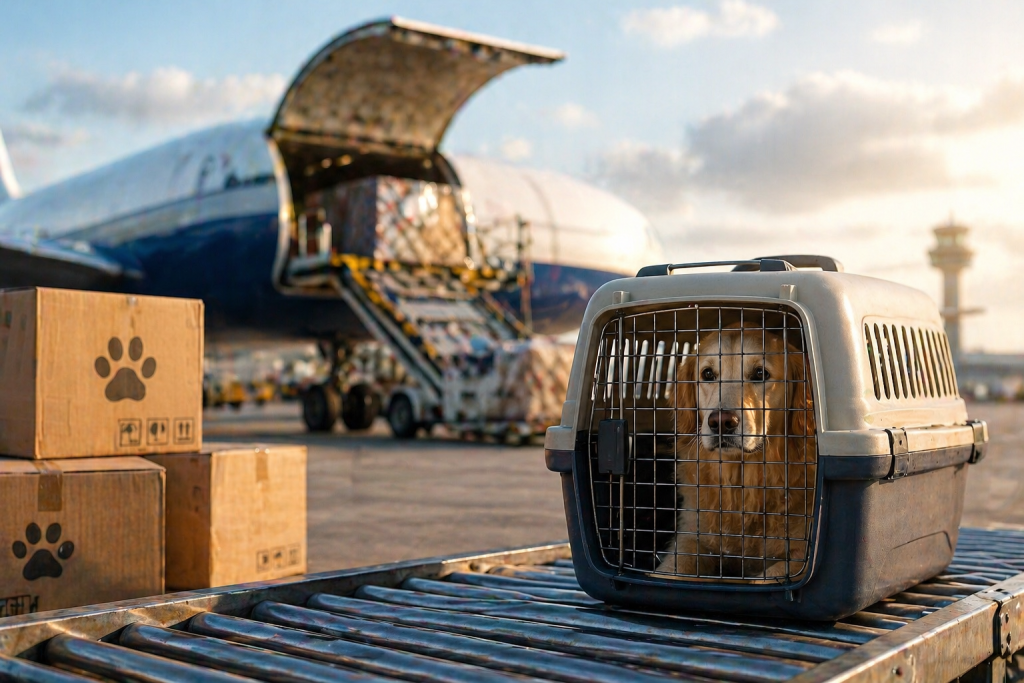

When planning a trip with pets, owners often make the critical mistake of applying the same preparation methods to different species. However, transporting cats vs dogs involves fundamental differences dictated by physiology, psychology, and safety requirements. In this article, we will break down how to prepare your pet for the road, minimize risks, and explain why the strategies for “man’s best friend” and the “cat that walks by itself” must be radically different.
Psychological Aspect: Stress Factors and Reaction
The first and most significant difference dictated by transporting cats vs dogs lies in the perception of space and the safety factor.
- Dogs are “social” travelers. For most canines, the primary safety anchor is the pack leader (the owner). If the owner is nearby and remains calm, the dog adapts to the new environment (airport, car cabin) much faster. For them, stress is primarily about separation, not the change in scenery.
- Cats are “territorial” animals. For them, safety is synonymous with predictability and familiar surroundings. Removing a cat from its home is equivalent to losing control over its world. Therefore, transporting cats vs dogs requires cat owners to start preparing the carrier as a “secure portable home” much earlier.
Preparation Features: Documents and Gear
When discussing transporting cats vs dogs, legal requirements (vaccinations, microchips, certificates) are usually identical. However, the technical side of preparation differs drastically:
- Container Selection: For dogs, volume is critically important. According to IATA Live Animals Regulations (LAR), a dog must be able to stand at full height without its ears touching the ceiling and turn around 360 degrees. For cats, an oversized carrier can be dangerous; during turbulence or sudden braking, the animal can be injured by being tossed around the box. A cat needs a cozy, compact, yet well-ventilated space.
- Crate Training: A dog can be trained to a crate through positive reinforcement (games, treats, commands). Cats are trained using a “passive habituation” method, turning the carrier into a sleeping spot several weeks before the flight.
Transporting Cats vs Dogs: Physiological Differences in Transit
During the journey, the physiological needs of the species differ as much as their behavior. This is a critical point for the pet’s health:
- Exercise and Hygiene: Dogs (especially large and young ones) need stops every 3–4 hours to stretch their muscles and relieve themselves. In the case of air travel in the cargo hold, this is impossible, so multi-layer absorbent pads are used. Cats can hold it for up to 12–15 hours, but their metabolism under stress often slows down or, conversely, causes acute intestinal spasms.
- Thermoregulation: Transporting cats vs dogs requires different temperature controls. Dogs, especially brachycephalic breeds (pugs, bulldogs), are extremely prone to heatstroke due to the structure of their nasopharynx. Cats, on the other hand, have a higher body temperature and are extremely sensitive to drafts and air conditioners running at full power in aircraft cabins.
Comparative Preparation Table by Stages
| Parameter | Dogs | Cats |
|---|---|---|
| Primary Fear | Separation from owner | Change of territory |
| Stress Reaction | Barking, rapid breathing, destructive behavior | Freezing, aggression, hypersalivation |
| Hygiene | Requires walking (or pads) | Needs a litter box (or absorbent layer) |
| Sedation | L-theanine or Tryptophan-based | Pheromones (Feliway) and hiding spots |
Експортувати в Таблиці
Air Travel Specifics: Cabin or Cargo?
When it comes to choosing a seat on a plane, transporting cats vs dogs once again demonstrates its unique nuances. Most cats (weighing up to 8 kg including the carrier) are allowed in the cabin. This is preferable as the cat can smell the owner. However, in the cabin, a cat may begin to meow loudly, which requires a “calming cover” (a thick fabric covering the mesh).
For dogs, especially medium and large breeds, the cargo hold is the only option. Here, the quality of the aviation crate plays a key role. Modern aircraft have heated compartments, but the psychological state of a dog in isolation is much heavier than that of a cat, which often simply falls into a protective sleep in the darkness of the crate.
Expert Tips for Minimizing Stress
WSAVA (World Small Animal Veterinary Association) specialists emphasize that transporting cats vs dogs should be accompanied by medicinal or pheromonal support for the nervous system.
- Pheromone Therapy: For cats, using sprays with synthetic pheromones (analogous to those a cat leaves by rubbing its face against objects) is the “gold standard.” For dogs, “anxiety vests” (like Thundershirt) that create a constant gentle hugging effect work more effectively.
- Light and Sound Management: Cats feel calmer in semi-darkness and silence. For dogs, if they are flying in the cabin, it is important to see the owner’s reassuring gaze and hear their voice.
Safety Risks: Why do Cats Escape More Often?
Statistics show that during transit transfers or customs checks, cats go missing far more frequently. The reason is that when transporting cats vs dogs, cat owners often underestimate the “liquid” flexibility of their pets. A frightened cat can squeeze through a gap only a few centimeters wide.
Important: Always put a secure anatomical harness on the cat inside the carrier. If you need to remove the animal for a veterinary inspection at the airport, the harness and leash will allow you to restrain the pet during a sudden jump attempt.
Regulatory Sources for Study:
- IATA – Traveler’s Pet Corner — Knowledge base for aviation container standards.
- AVMA (American Veterinary Medical Association) — Scientific recommendations for feeding and watering animals in transit.
- International Cat Care — Expert articles on cat behavior during transport.
Conclusion
In summary: transporting cats vs dogs involves two fundamentally different projects. A dog needs a leader, physical comfort, and clear commands. A cat needs stability, darkness, and a sense of “its own fortress.” Understanding these fundamental differences will allow you to organize your trip so that your beloved pet arrives at its destination in good health.
Regardless of whether you are transporting cats vs dogs, remember: the key to success is early preparation (at least 4–6 weeks in advance) and a mandatory consultation with a veterinarian who knows the medical history of your specific animal.

To receive a personalized calculation of transport costs and to arrange all necessary permits, please contact our specialists via the website form.